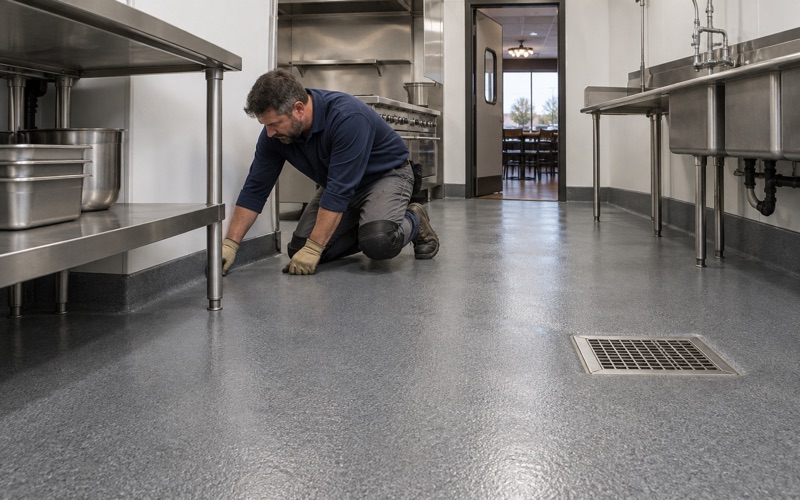
West Des Moines Epoxy Flooring has spent more than 20 years on epoxy flooring in Windsor Heights and across the metro, and the question we hear most from people who run rooms for hire is not how hard a floor is. It is what the floor will look like after the hundredth party, and what happens the day someone drags a loaded cart through the middle of it.
A decorative resin floor answers those questions differently depending on how it was built. A poured marble or metallic finish is a single piece of artwork, while a broadcast system is a field of small particles that hides wear by design. Neither is wrong, but each one sets the terms for every repair the room will ever need.
This page walks through that choice for reception halls and party rooms: how stone-look resin is made, why its pattern cannot be matched after a gouge, how the clear topcoat carries the daily wear, and when a flake or quartz floor is the more forgiving buy for a space that turns over every weekend.
Event Halls on Hickman Road
Much of the celebration business in Windsor Heights runs along Hickman Road. Sherwood Forest Event Center, also listed as The Ridgemont, at 7400 Hickman Road is a multipurpose space for weddings, corporate events and concerts, and farther along the same road sits a hall that puts its floor right in the sales pitch.
Agora Events Center and Its Stone-Colored Floor
Agora Events Center at 7694 Hickman Road describes a vaulted indoor reception hall that is stunning “all the way from the beams and modern lighting” to “the natural stone colored floor.” The hall is marketed for a small wedding, baby shower, quinceañera, corporate event or birthday party, with a second room and a fully equipped kitchenette included in the rental.
We want to be plain about what we know. Agora’s page does not say what that floor is made of, it may not be resin at all, and we have no connection to the venue. We mention it because it shows how a hall owner on this road sells a room: the floor is part of the look a couple is paying for, named in the same breath as the beams and the lighting.
What a Rental Floor Goes Through Between Bookings
A rented hall is judged on appearance that has to survive tables and chairs set and struck, an evening of dancing, spilled drinks and dropped cake, then a cleanup crew working fast before the next booking. The floor is not resting between uses the way a house floor does; it is being reset.
That changes how we think about a decorative coating for an event room. The useful questions are how scuffs show under the lighting, how quickly a damaged area can be dealt with, and whether the fix will be visible the following Saturday. Those answers depend almost entirely on whether the color was poured as a continuous pattern or broadcast as loose particles.
Looking for epoxy-flooring closer to Waukee? See Waukee Epoxy-Flooring.
Floors That Imitate Stone: Marble and Metallic Resin
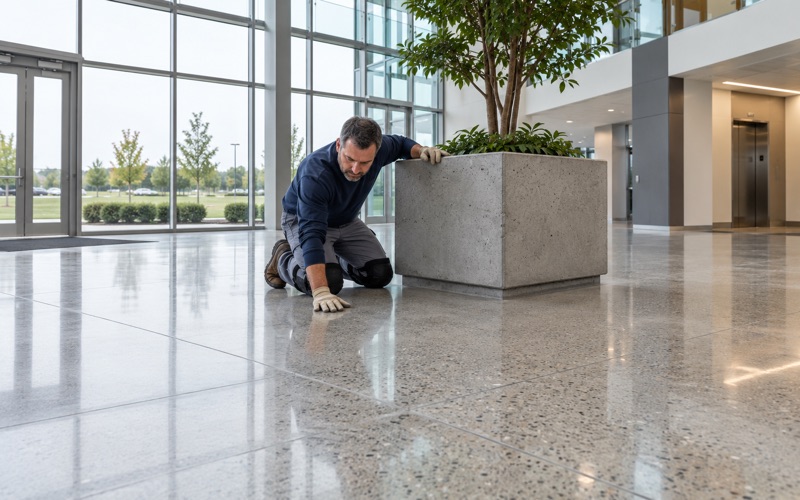
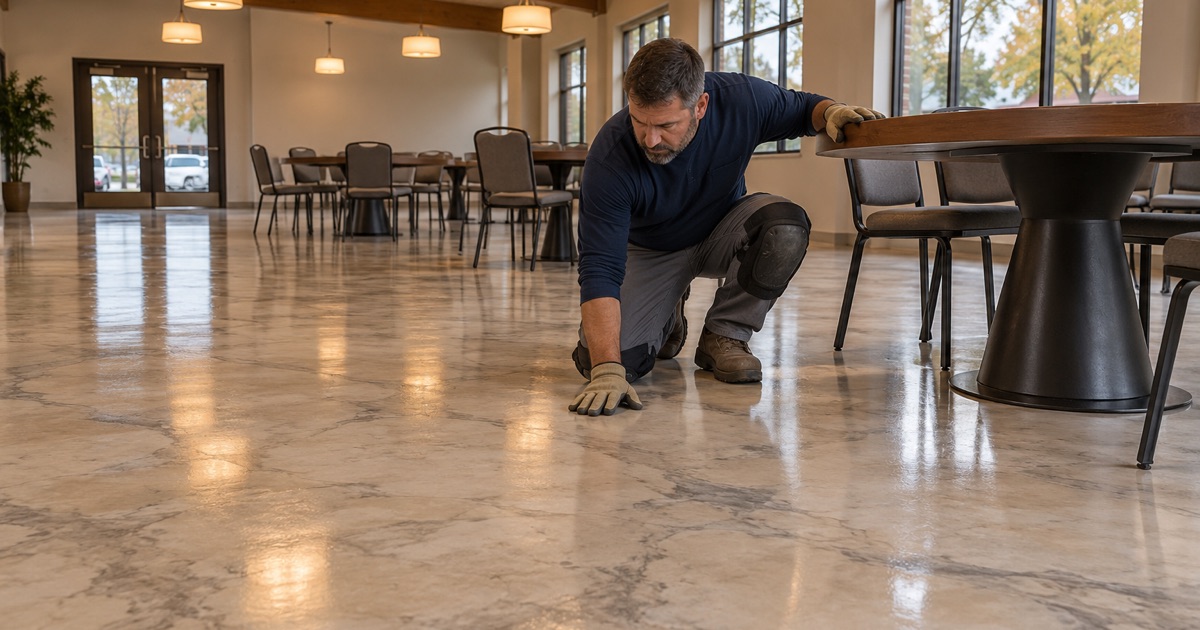
Stone-look resin is popular in reception spaces because it reads as polished marble or a deep, moving metallic sheen without the cost and seams of real stone slabs. The finish is produced on site, in liquid form, by the installer’s hands and tools.
How Marble Veining and Metallic Movement Are Made
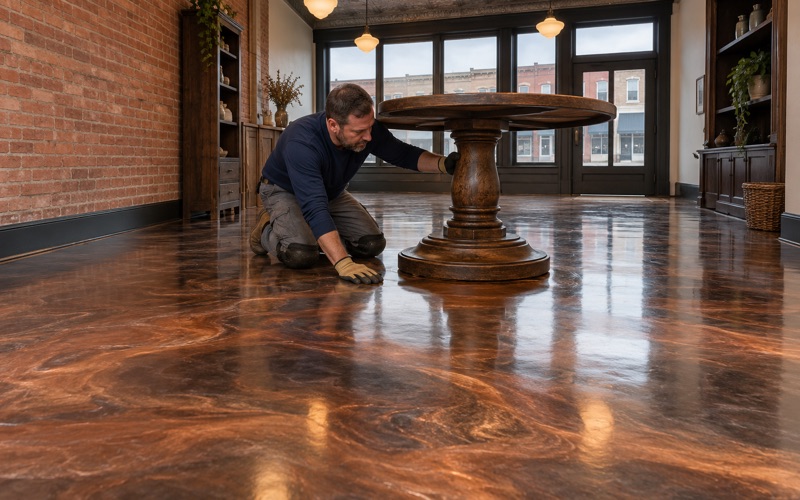
One installer and manufacturer describes how advanced techniques can produce a marble epoxy floor effect whose results “closely resemble natural marble veining.” Metallic floors work the same way: pigment is suspended in the resin, and the pattern comes from manipulating the wet material with squeegees, rollers or blowers before it begins to set.
A flooring guide puts the consequence simply: metallic pigments “never settle the same way twice.” The swirls, depth and color shifts in a finished hall are the record of one crew’s work on one day with one batch of material. That uniqueness is the reason people choose it, and it is also the reason it behaves the way it does when damaged.
Why a Poured Pattern Cannot Be Patched to Match
When a gouge goes through the clear coat and into the colored layer, there is no way to recreate the surrounding veining in a small spot. The new material will not flow the same way, the pigment will not settle the same way, and the edge between old and new tends to show under event lighting. A homeowner described this exact problem on a forum: a damaged section was quoted for replacement “with material that won’t match since what’s there was laid all at once.”
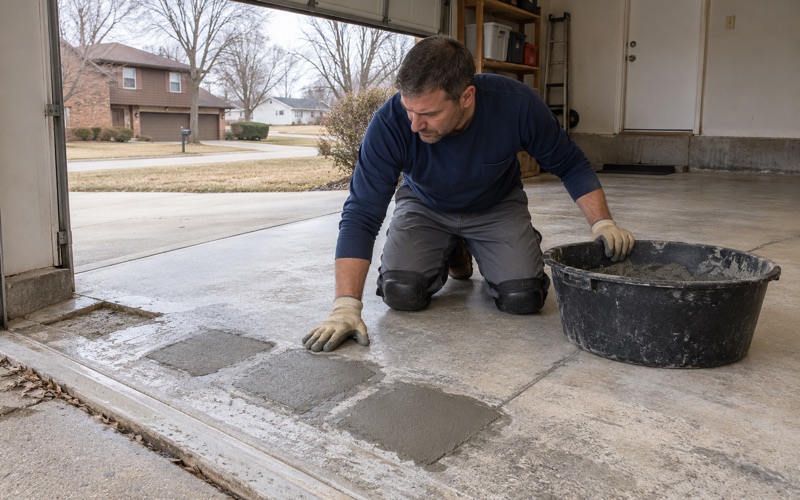
We will not promise an invisible repair to a marble or metallic pattern, and nobody should. The honest options are a patch that is visible but clean, recoloring a larger area to a natural break line such as a wall or doorway, or redoing the field. That is why protecting the colored layer matters so much more on these floors than on any other system we install.
Preparing the Slab Under a Decorative Pour
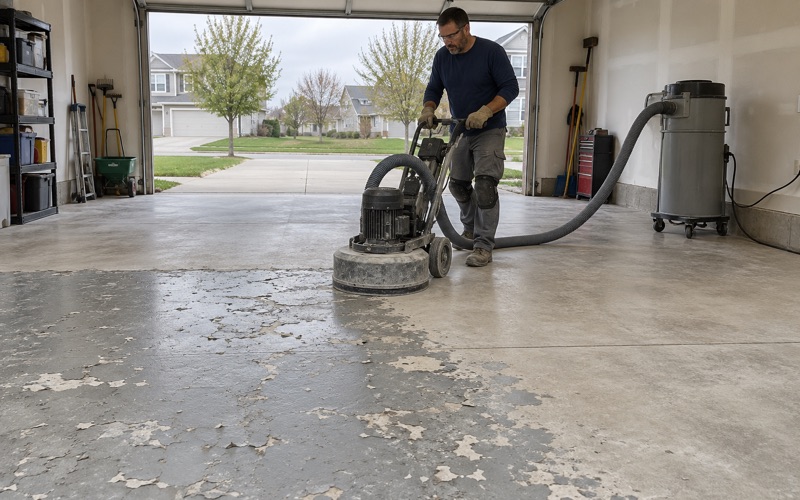
A decorative pour shows every flaw beneath it, so preparation is where the floor is really won. We open the concrete with a diamond grinder or a shot blaster rather than an acid etch, map cracks, spalls and any old coating before pricing, and tell an owner directly if the slab should be repaired before it is coated.
Moisture is tested as part of the written scope before the price is final, because vapor coming through a slab can lift or haze a clear finish. Our proposal names the product line, the number of coats and the finished thickness, so an owner can hold the completed floor up against the quote line by line.
The Clear Topcoat Is the Layer That Wears
On a stone-look floor, the part that takes the abuse should be the clear topcoat, not the art beneath it. The same maker notes that “a clear topcoat seals the floor, adds UV and chemical resistance, and enhances gloss or matte finish.” Every scuff from a chair leg and every haze from foot traffic belongs in that layer.
Recoating the Whole Room Instead of Patching a Spot
Because the topcoat is clear and uniform, it can be lightly abraded and recoated across the entire room without touching the pattern underneath. That is the maintenance model we recommend for a hall: let the topcoat take the wear, then renew it room-wide before wear reaches the color. The maker’s guidance is that commercial floors may need recoating every 5 to 10 years, and a busy hall’s own booking calendar will show where in that range it falls.
A room-wide recoat also avoids the mismatch problem entirely, since nothing about the pattern is being redone. The gloss level can even be changed at that point, from high shine to satin, if the owner wants the room to photograph differently under its lights.
Scheduling Work Around a Booking Calendar
A hall that is booked most weekends cannot close for a week on short notice. We phase work around business hours and use overnight and weekend windows when a space cannot shut, and we set cure times by slab temperature and dew point rather than a fixed calendar date, so the room is not handed back before the coating is ready for tables.
Slip resistance is part of that plan too. A smooth, glossy marble finish is lovely to look at, but a dance floor with spilled drinks needs some grip, and we specify texture through the topcoat and any additive used rather than describing a floor as slip-proof.
Daily Care Between Events
Much of the everyday wear on a decorative floor comes from grit underfoot. The maker’s maintenance advice is to sweep or dust mop regularly, clean spills immediately and use pH-neutral cleaners, and that routine is what keeps the topcoat from dulling ahead of schedule.
Felt pads under chair and table feet earn their place in any hall, and so does a walk-off mat at the entry, where outdoor grit first meets the floor. Neither item costs much, and both push back the day the room needs a recoat.
Flake and Quartz: Decorative Floors That Forgive Repairs
Not every event room needs to look like poured stone. A broadcast floor is decorative in its own way, and for a hall that hosts several parties a week it is often the more practical choice.
How a Broadcast Hides Scuffs and Takes Local Repairs
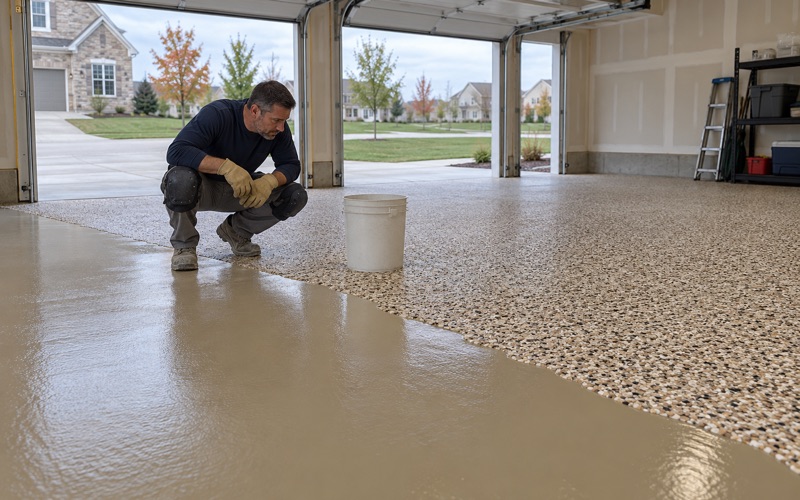
A vinyl flake or quartz aggregate broadcast scatters thousands of colored chips or grains into the resin, then locks them under a clear topcoat. The random, speckled surface hides the small scuffs and scratches that would stand out on a glossy marble field, which is why these systems are common in high-traffic commercial rooms.
When a section is damaged, it can be ground out, rebuilt and rebroadcast with the same blend, and the new area tends to disappear into the existing pattern far better than a poured repair ever could. It is not invisible, and no floor is scratch-proof, but a local fix on a broadcast floor usually reads as part of the floor rather than as a patch.
Choosing Between a Stone-Look Pour and a Broadcast Floor
The decision comes down to how the room earns its money. If the floor is part of what a couple is buying, a marble or metallic pour delivers that look, provided the owner accepts that topcoat maintenance is not optional and a deep gouge means a visible repair or a larger redo.
If the room turns over constantly and a scuffed area has to be fixed between a Friday party and a Sunday shower, a flake or quartz broadcast keeps repairs local and quick. We walk through both options with samples, explain what a coating warranty leaves out before anything is sold, and let the room’s booking pattern make the call.
- 20+ Years in Epoxy Flooring
- Moisture Tested Before Pricing
- Coats and Thickness in Writing