West Des Moines Epoxy Flooring brings more than 20 years of epoxy flooring in Waukee and the surrounding metro to rooms that get scrubbed far harder than they get admired. This page is written for one kind of owner above the rest: the veterinary practice, where the floor is part of how a room is made ready for the next patient. For that owner the useful questions are about pores, seams and chemistry, and very little about color.
Our part of the answer starts before any resin is opened. Every slab is profiled with a diamond grinder or a shot blaster, never an acid etch, so the coating locks into opened concrete instead of sitting on a skin. A moisture test is written into the scope before the price is final, and the proposal names the product line, the number of coats and the finished thickness, so a practice manager can hold the finished floor up against the paperwork.
We are just as plain about the limits. A floor coating is not a disinfectant, it does not kill anything, and it cannot make up for a cleaning protocol that is skipped. What it can do is give the disinfectant a surface with nowhere to hide, and we tell an owner up front when a slab needs crack repair or replacement before it deserves a coating at all.
A Waukee Animal Clinic and the Rule Under the Exam Table
A Practice on NW 4th Street
Waukee is a Dallas County city in the Des Moines metropolitan area, counted at 23,940 people in 2020 and estimated at 34,890 in 2025. Broderick Animal Clinic, at 10 NW 4th Street, has cared for the town’s dogs and cats since it was established in 1991, offering exams and vaccinations, surgery, dental care, boarding and bathing. It is a fair picture of the kind of practice Iowa’s facility standard is written for.
We should be clear about what we do not know. We have no relationship with Broderick Animal Clinic, we have not seen its floors or its layout, and nothing on this page describes them. We use the clinic only because a long-running Waukee practice offering surgery and dentistry shows why the state’s wording matters to anyone flooring an exam or treatment room in town.
What 811 IAC 12.5 Says About Floor Coverings
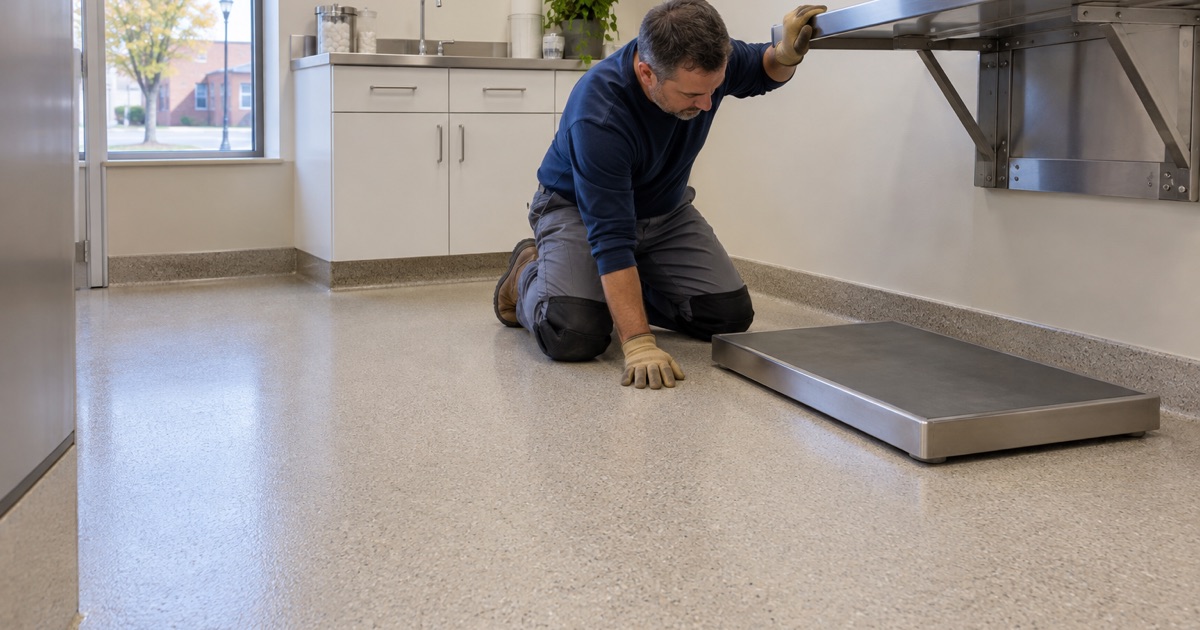
The Iowa Board of Veterinary Medicine sets facility standards in 811 IAC chapter 12, revised under ARC 8021C and effective July 1, 2024. Rule 12.5(1) applies to all facilities used by a licensed veterinarian to provide veterinary services. Where patients are examined and kept for treatment or hospitalization, 12.5(1)(a)(2) calls for nonporous tabletops, countertops and floor coverings that can be adequately cleaned and disinfected.
The same item appears again for service-only facilities that handle exams or vaccinations, and for mobile clinics. In other words, the floor-covering line does not switch off because a practice does not keep patients overnight. A small wellness clinic and a full surgical hospital are both expected to stand on something a disinfectant can actually work on.
An Outcome, Not a Product Name
The rule describes a result rather than naming a material, which is the right way to read it. Sheet vinyl, sealed tile and a seamless resin system can each be argued to fit, and each can fail the description once seams open or a surface wears through. We do not claim any board approval for our floors, and we hold no credential that signs off on a clinic’s compliance.
What we can do is build a floor that plainly matches the words: no exposed concrete, no open joints, and a surface that tolerates repeated wet cleaning. We document the system, the coats and the thickness in writing so the practice has a clear record of what went down and why.
Looking for epoxy-flooring closer to Urbandale? See Epoxy-Flooring in Urbandale.
Disinfectant on the Floor: Pores, Seams and Dwell Time
Why Bare Concrete Is Not Nonporous
Concrete is full of capillary pores, and anything mopped across it soaks in rather than staying on the surface. Urine, blood and spilled medication travel into the slab, and the disinfectant chasing them never reaches the bottom of the pore. A lithium silicate densifier hardens the surface and cuts dusting, but it does not lay down the continuous film that turns a porous slab into a nonporous one.
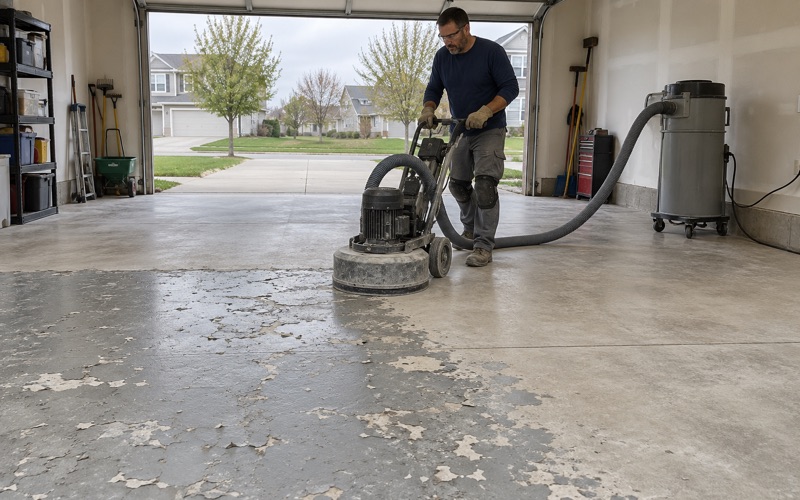
A coating closes that gap only if it bonds well and builds enough thickness to bridge the profile. That is why we grind to a measured ICRI CSP profile rather than etching, and why the proposal states a finished thickness. A thin roll-on coat over a poorly opened slab tends to wear through first at doorways and around the exam table, which is exactly where cleaning is heaviest.
Seams, Cracks and the Wall Line
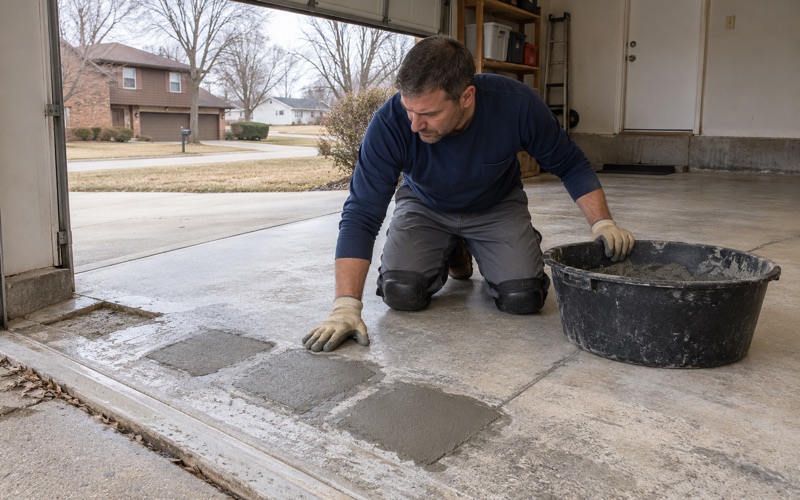
A nonporous field means little if the edges leak. Cracks, spalls and control joints are mapped before any work is priced, then filled or treated so the finished surface runs continuous across them. Sheet goods carry welded or taped seams, and a seam that has lifted is a channel that holds liquid out of reach of a mop.
Where the floor meets the wall, an integral cove base carries the resin up a few inches so there is no right-angle corner for debris to pack into. That detail matters most in rooms that are wiped down many times a day. It is also where we are honest when an existing wall or base is too damaged to cove cleanly without other repair first.
Dwell Time and What a Floor Cannot Do
Every EPA-registered surface disinfectant carries a contact time on its label, the number of minutes the surface has to stay wet for the claimed kill. A floor that sheds liquid into pores, or a heavy texture that breaks a film into droplets, makes that contact time harder to meet. A smooth to lightly textured resin surface lets the solution sit where it was applied.
The coating’s job ends there. It does not disinfect, it does not stop transmission on its own, and we never sell a floor as antimicrobial protection for a clinic. The protection comes from the practice’s own products and protocol; the floor’s role is to make sure those products reach every square inch they are meant to.
Keeping Contagious Patients Apart Without a Floor That Carries Them
What 12.5(1)(a)(4) and 12.5(2) Add
The same rule asks for appropriate separation of patients with known or suspected infectious and contagious diseases from those not known to have them, in a way that reasonably guards against transmission. Rule 12.5(2) adds that a facility must keep a safe and sanitary environment that protects patients and guards against the transmission of infection.
Separation is the practice’s decision, made in its own layout and procedures. The floor supports it in a narrower way: the room a contagious patient used has to be cleaned and disinfected completely before the next patient comes in, and a floor with pores or failed seams turns that full cleaning into a partial one.
Continuous Surfaces Across Thresholds
Doorways are where floors most often change material, and transitions are where dirt and moisture collect. When a practice coats an exam room but leaves an old floor in the hallway beside it, we look closely at that joint so the edge is sealed and flush rather than a lip that traps residue.
Some owners also use color to mark rooms or zones, a choice that helps staff read a space at a glance. That is a practice preference, not a requirement we attach to any rule, and it is easy to plan for when the system is chosen. A mid-gray hides everyday scuffing better than white, which shows every mark, or a very dark tone, which shows dust and dried residue.
Working Around an Open Practice
Animal clinics rarely close for a week. We phase treatment, exam and boarding areas around the schedule, using overnight and weekend windows when a room cannot come out of service during the day. Grinding dust is captured at the machine with a vacuum rather than swept or rinsed, which matters in a building full of animals and the people caring for them.
Low-odor products are available where a practice wants staff and patients back in a space sooner. We offer them as a comfort and re-entry choice, never as something Iowa law requires. Cure schedules follow slab temperature and the dew point at the surface rather than the calendar, so a room is returned to use when the coating is ready.
Choosing a System for the Cleaner the Practice Actually Uses
Start With the Product on the Shelf
The first thing we ask a clinic for is the label and safety data sheet of each disinfectant it mops with. Quaternary ammonium blends, accelerated hydrogen peroxide and diluted bleach all behave differently on a cured resin, and a floor that tolerates one can dull, yellow or soften under another over many months of daily use.
We weigh the topcoat against that real list rather than against a single manufacturer’s generic resistance chart. When a practice rotates products or plans to switch, we plan for the harshest one in the rotation. On a doubtful match, a cured test area treated with the clinic’s own solution tells more than any brochure.
Building the Layers
A common build for a treatment room is a 100% solids epoxy body coat for thickness and bond, then a polyaspartic or polyurethane topcoat chosen for chemical and abrasion resistance. Where a room sees hot-water washdown or harsh chemistry, urethane cement is a stronger fit than a standard epoxy, and we say so even though it costs more.
Texture is specified, not promised. A fine quartz aggregate broadcast locked under the topcoat gives wet footing for staff carrying animals, while staying fine enough for a mop to clean. The proposal names the broadcast and topcoat, so slip resistance is a written detail rather than a slogan.
Moisture Before Any of It
None of this holds if water pushes up through the slab. We measure with ASTM F2170 in-situ relative humidity probes or ASTM F1869 calcium chloride tests, and a moisture-mitigation primer goes into the scope when the readings call for it. A newer building gets the same test as an old one, because construction year says little about a given slab.
Moisture is also the first exclusion we explain in any coating warranty, along with hydrostatic pressure. A practice manager should know before signing what the warranty covers, what it leaves out, and what we found in the slab, so there are no surprises a year into daily disinfection.
- 20+ Years in Epoxy Flooring
- Moisture Tested Before Pricing
- Coats and Thickness in Writing