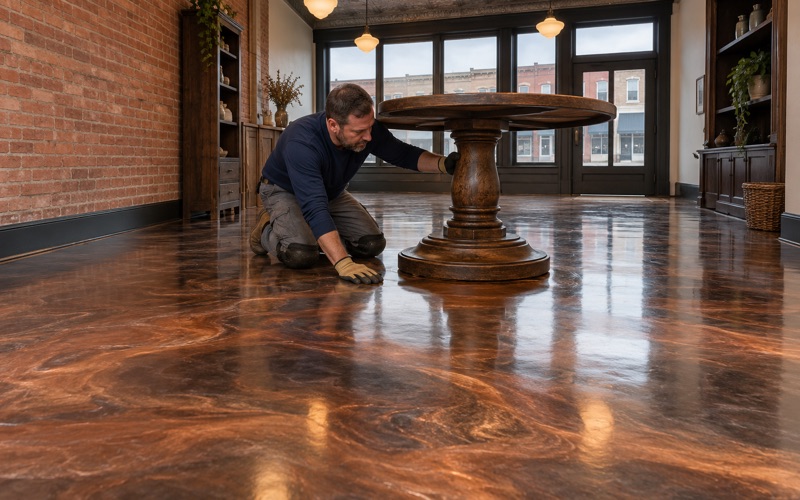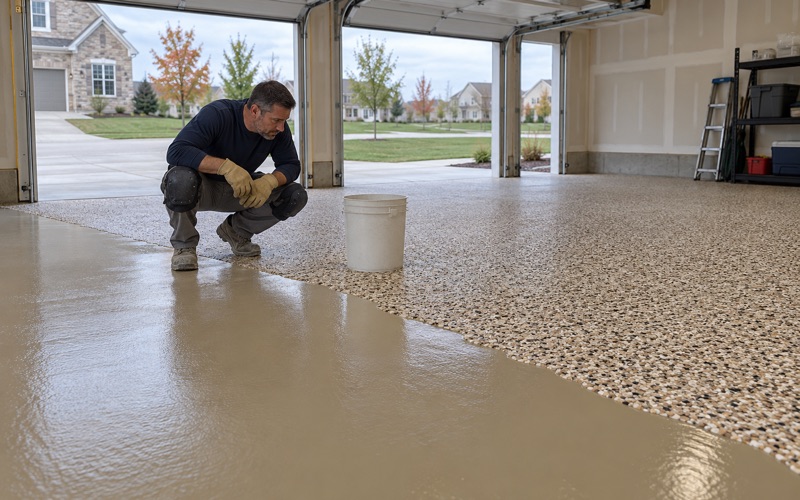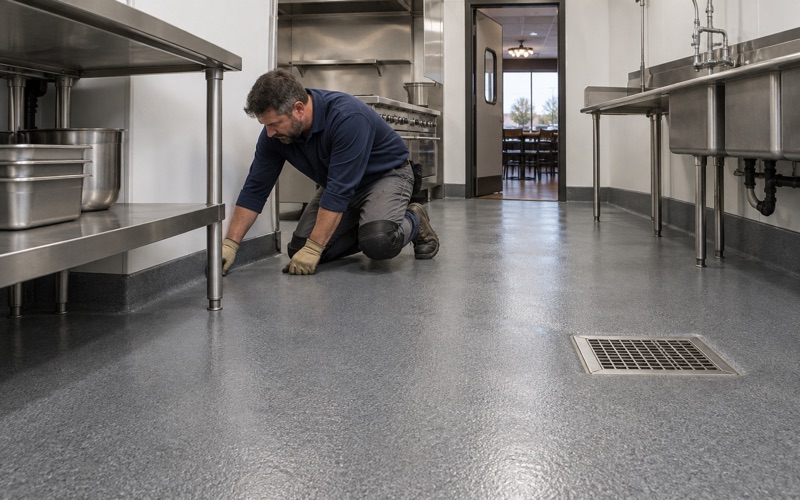
West Des Moines Epoxy Flooring has spent more than 20 years on epoxy flooring in Polk City and around the metro, and the garages here tend to raise a narrower question than most: what happens to a coated floor when a snowmobile lives on it for four months? We work that question out before we quote. The answer decides the texture, the topcoat and how the sled reaches its parking spot.
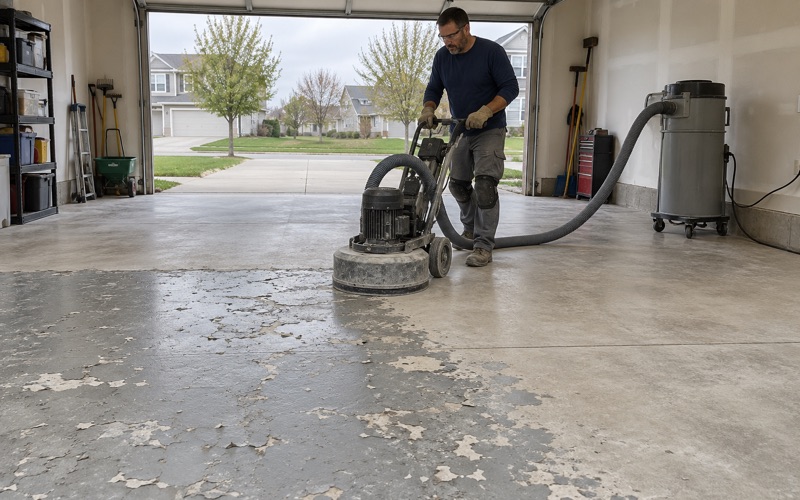
Every slab we coat is opened with a diamond grinder or a shot blaster, never an acid etch, so the coating bonds into a real surface profile instead of sitting on a weak skin. A moisture test goes into the written scope before the price is final, and we run it whether the house went up in 1975 or last spring.
Our proposal lists the product line, the number of coats and the finished thickness, so you can hold the finished floor up against the paper. It also spells out what the coating warranty leaves out, starting with moisture, and it says plainly what no coating can do against a steel ski runner.
Sleds, Shelters and the Big Creek Winter
An 11-mile trail around the lake
Big Creek State Park sits at the edge of town, and its 814-acre lake is circled in winter by an 11-mile snowmobile trail, according to the Iowa DNR park brochure. Groomed cross-country ski trails run through the Hampton picnic area as well. For plenty of households here, winter is a riding season rather than a waiting one.
That season ends in the garage. A sled coming off the trail rolls onto the same slab the family car parks on, often with packed snow still in the track and ice on the skis. We plan a Polk City garage floor knowing a trail machine will be pushed, pivoted and lined up on it from the first good ice until spring.
February 20 and the shelters coming home
Ice anglers work Big Creek and Saylorville Lake through the hard-water months, and Iowa DNR notices set February 20 as the date unattended ice fishing shelters have to be off state-owned lands and waters, including frozen lakes, parking lots and boat ramps. Owners camping in a paid state-park campsite are the exception. The rule is about public land, but its effect lands on private floors.
A shelter pulled off the ice usually rides home behind a sled or on its own runners and gets parked in the garage or shop until next season. Augers, heaters, rod cases and the machine that towed everything come in the same week. A floor that looked roomy in January becomes a crowded storage bay by late February, and the coating underneath carries all of it.
Young houses, same moisture test
Polk City’s housing is young and mostly owner-occupied: 58.9 percent of its units were built in 2000 or later, and 1,947 of 2,184 occupied homes are lived in by their owners. That makes for a lot of attached and detached garages that have never had anything on them but sealer and tire marks.
A newer slab is not automatically a safer one, though. We test the moisture in a garage poured a few years ago exactly the way we test one from the 1970s, because the build year says nothing reliable about what is moving up through the concrete. The reading goes into the written scope, and if it rules out a coating, we tell you before you pay for one.
Looking for epoxy-flooring closer to Indianola? See Indianola Epoxy-Flooring.
What Carbide Runners and Studded Tracks Do to a Floor
Hardened steel on concrete
Snowmobile skis ride on carbide runners, steel wear bars with carbide inserts built to bite into ice. On a garage floor they bite into whatever is under them. Garage-forum owners have described carbides leaving grooves about 1/8 inch deep, on bare concrete and coated floors alike. That figure is owner anecdote rather than a test result, but it is consistent with the scars we find where a sled has been dragged across an unprotected slab.
Studded tracks add a second kind of wear. Traction studs stand proud of the track lugs, and a machine that is started, idled or spun to line it up on the floor drives those points into the surface. The damage shows up as clusters of short, sharp scratches right where the track sat.
Why no coating is carbide-proof
We say this in the first conversation: there is no floor coating a carbide runner cannot mark. A 100% solids epoxy base, a polyaspartic or polyurea topcoat and a urethane cement system each resist abrasion differently, but none of them is a match for hardened steel pulled across it under the weight of a loaded sled. A contractor who promises otherwise is selling a slogan, not a floor.
What a well-chosen system can do is keep the damage shallow, hard to see and inexpensive to repair. That shifts the goal from a showroom finish that stays perfect to a working surface that still looks clean when the gear goes back out in spring. We build the rest of the plan around that honest target.
Mapping old grooves before the grinder starts
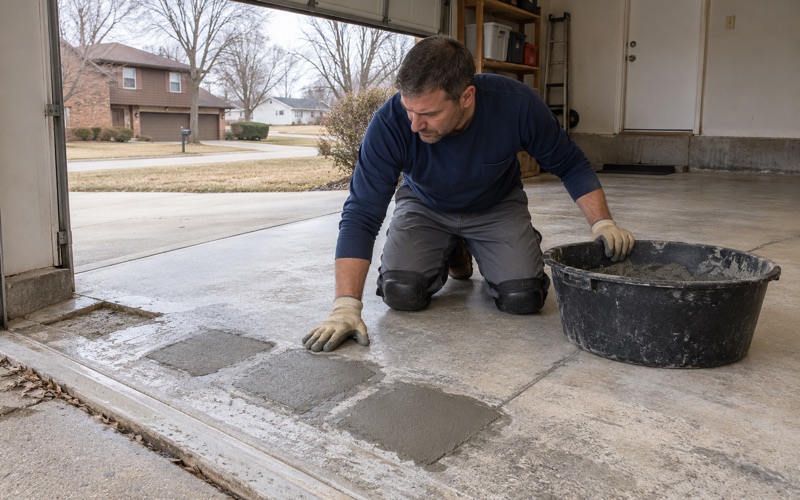
In a garage where sleds have already wintered for several years, we map existing grooves and gouges along with cracks, spalls and any old coating before prep begins. Shallow scratches grind out during the diamond pass. Deeper channels are filled and leveled ahead of the base coat so they do not show through the finished floor.
Sometimes the map shows more than coating can fix. A slab that is broken up along the sled path, or one with an old coating peeling across the whole bay, may need repair or replacement first, and we say so in writing rather than putting new material over a failing base.
Dollies, Runner Lanes and a Texture That Hides Scratches
Ski and track dollies
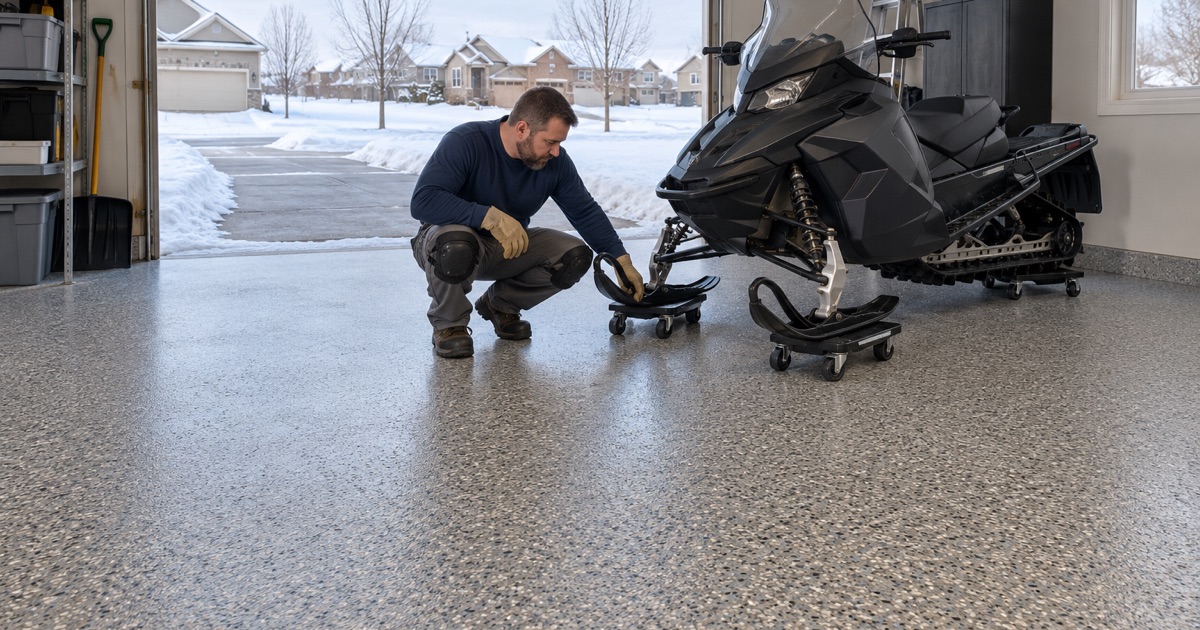
The most effective protection for a coated floor is keeping the carbides off it entirely. Dolly makers sell ski and track dollies with wheels designed so the skis never scrape the surface below, and with a set under it, a sled rolls into its spot instead of being dragged. The studs stay off the floor as well.
We recommend dollies to every Polk City customer who stores a snowmobile, and we lay out the parking spot with them in mind. The floor is coated wall to wall; the dollies do the protecting. Treating the two as one plan is what keeps a new floor looking new after its first riding season.
A sacrificial runner lane
Some owners want a backup for the nights when the dollies are still in the trailer or the sled comes in late and wet. A sacrificial runner lane covers that case: a removable rubber runner or mat laid along the path from the door to the parking spot, taking the carbide scratches so the coating beneath does not. When it is chewed up, it is replaced for a fraction of the cost of a recoat.
A lane works best where the route from the door is short and straight, so we look at that path during the site visit. An ice shelter on its own runners can use the same lane, which keeps the late-February unloading from scoring a fresh floor.
Broadcast texture that hides fine scratches
A smooth, solid-color floor shows every mark. A full vinyl flake broadcast or a quartz aggregate broadcast breaks up the surface visually, so a fine scratch disappears into the pattern instead of reading as a bright line across the bay. Slip resistance comes from the same broadcast and the topcoat over it, and we specify both in the proposal rather than promising grip as a slogan.
Color choice matters here too. Mid-tone flake blends hide light topcoat scratches far better than dark solids, which show a white scuff from across the garage. We bring samples and set them down under the light where the sled will actually park.
Recoating the Bay That Takes the Winter Gear
A topcoat built to be renewed
The topcoat is the layer that takes the punishment, so we treat it as a wear layer meant to be renewed. A polyaspartic or polyurea topcoat over a broadcast floor can be scuff-sanded and recoated after a few seasons of sled traffic without grinding back to bare concrete, as long as the scratches stayed in the topcoat and did not cut through the broadcast below.
That is one reason the proposal states finished thickness. A known topcoat build tells you how much wear the bay can absorb before it needs attention, and it gives us a number to check against when you call us back for the recoat.
Timing a recoat around the gear
The natural window for a recoat is after the sleds and shelters move out for the summer and the bay is empty. Our cure schedules follow slab temperature and the dew point at the surface, not the calendar, so a cold, unheated garage in the middle of an Iowa winter is told to wait rather than rushed.
Recoat prep is lighter than a first install, but it still makes dust. We capture it at the machine with a vacuum rather than rinsing it toward a floor drain or out the door. For an attached garage, we can offer a low-odor product as a comfort and re-entry choice, so the house is livable while the new topcoat cures.
The rest of the winter load
The sled is rarely the only thing in the bay. The car parked beside it brings in brine and rock salt on its tires from November through March, and hot tires coming off the road can lift a weak coating. We choose garage systems with that salt exposure and hot tire pickup in mind, so the half of the floor that never sees a carbide holds up as well as the half that does.
None of this means a coating can stop water moving through a slab, and we never sell it as if it could. What it does give a Polk City garage is a floor planned for the winter it will actually have, with honest limits written into the scope from the start.
- 20+ Years in Epoxy Flooring
- Moisture Tested Before Pricing
- Coats and Thickness in Writing