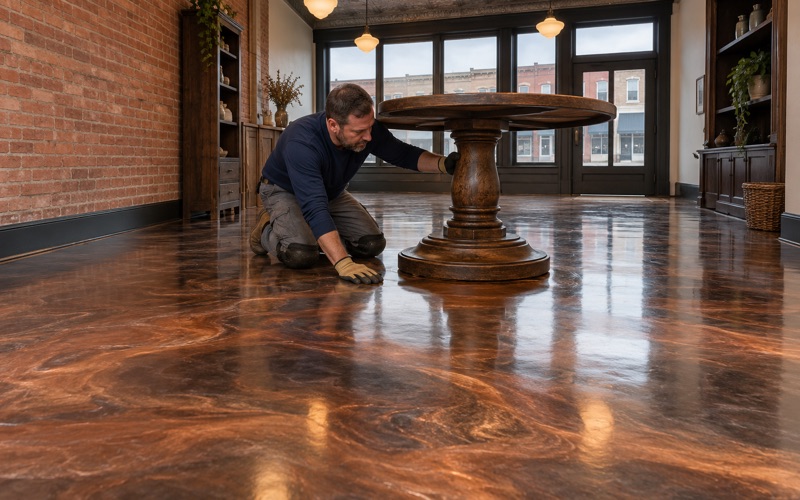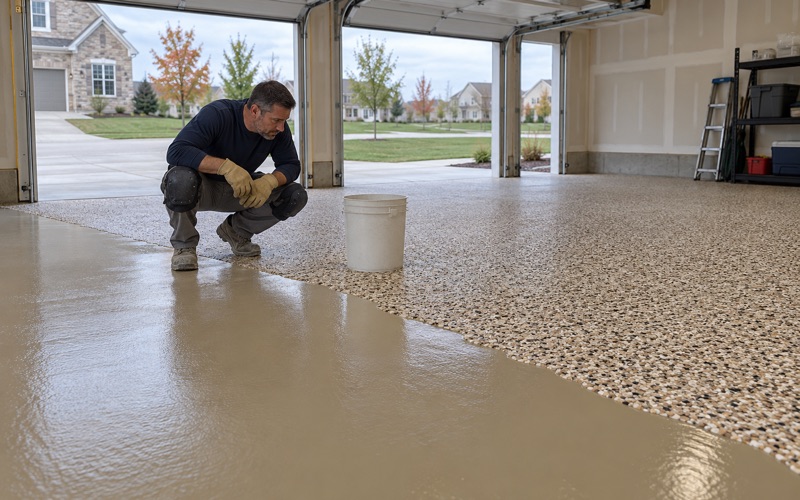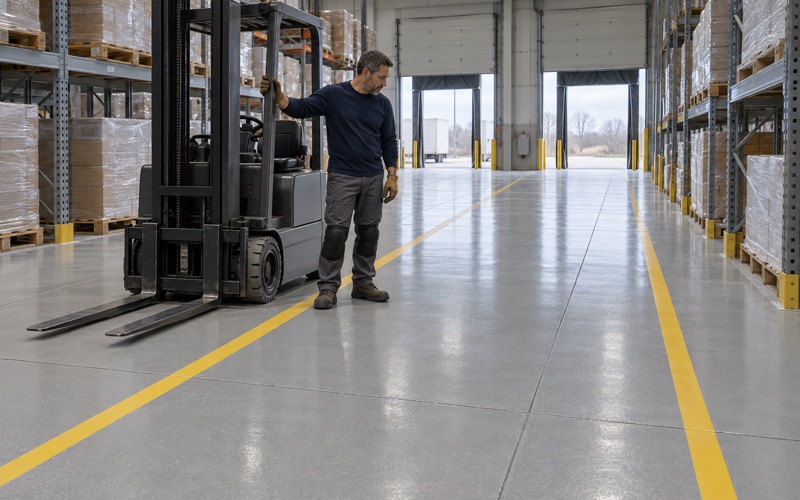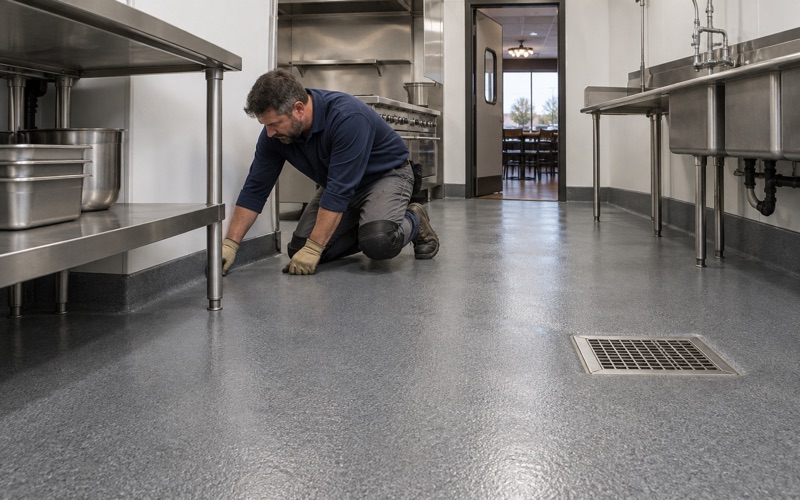
West Des Moines Epoxy Flooring brings more than 20 years of epoxy flooring in Perry to rooms that have to be washed, walked on and inspected, from guest baths and back-of-house corridors to attached garages and older basements. We are a flooring contractor, not an inspector, and we say so up front: our job is to put down a floor that suits the room and the base under it, and to put the details in writing.
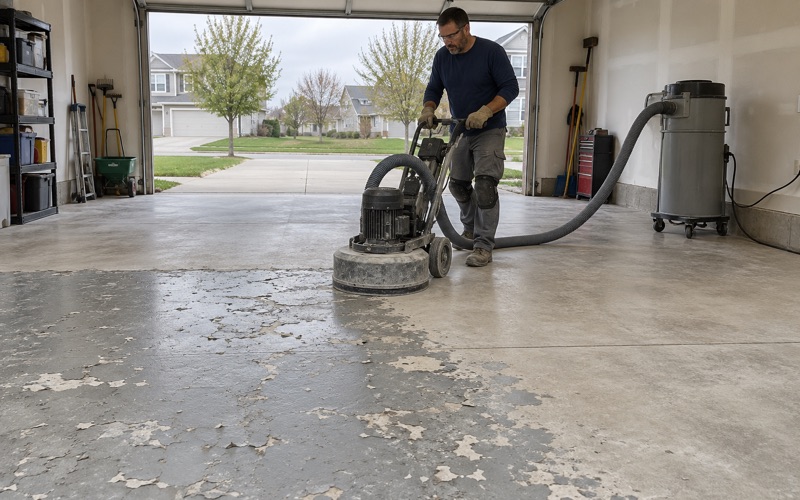
Every project starts with what is under the finish, not with the color chart. We open a concrete slab with a diamond grinder or a shot blaster rather than an acid etch, map the cracks, spalls and old coatings before pricing, and tell an owner plainly when a floor needs repair or replacement before anything should be coated over it.
The proposal you receive names the product line, the number of coats and the finished thickness, so the completed floor can be checked against the quote. A moisture test sits inside that written scope before the price is final, and the warranty’s exclusions are explained before the job is sold, with moisture named first.
A 1913 Hotel and the Rule Behind Its Guest Baths
Hotel Pattee on Willis Avenue
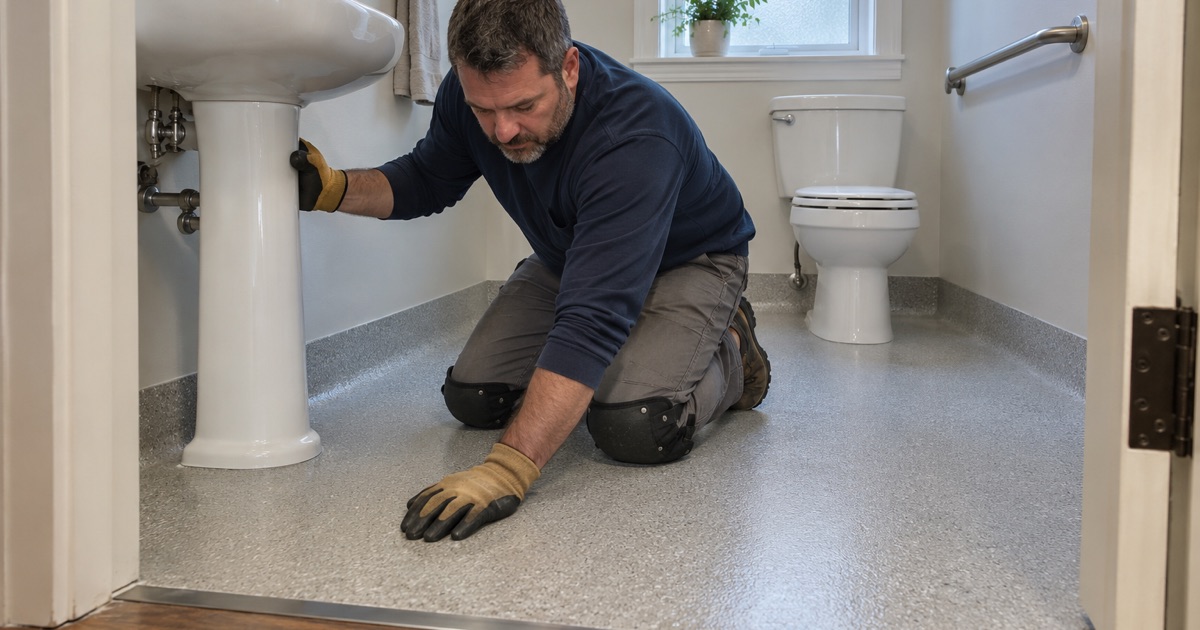
Perry is a city of 7,836 people at the 2020 Census, in Dallas County, Iowa, along the North Raccoon River and part of the Des Moines metropolitan area. Its downtown keeps a working hotel that predates nearly everything around it: Hotel Pattee, at 1112 Willis Avenue, which the Pattee family opened on May 29, 1913.
The hotel describes 40 individually decorated and themed guest rooms over three stories, along with a bowling center, a cafe and a ballroom. We have no relationship with the hotel and have not seen its floors. We mention it because it is the clearest local example of an old building that still answers to a current lodging rule.
What 481 IAC 37 Says About Floors
Iowa’s hotel and motel inspection rules sit in 481 IAC chapter 37, issued by the Iowa Department of Inspections, Appeals, and Licensing to carry out Iowa Code chapter 137C and readopted effective March 11, 2026. Rule 37.1 asks that floors, walls and ceilings be kept clean and in good repair.
Rule 37.4(1) is the one that reaches a flooring decision directly. Each guest room is to have hot and cold running water fixtures, and the floors are to be nonabsorbent and impermeable so they can be washed with water. Hotels are inspected under chapter 137C, and a violation is a simple misdemeanor, with license suspension or revocation also available to the state.
Bed and Breakfast Inns
The same chapter treats bed and breakfast inns differently. They are excused from putting lavatory facilities in every guest room, but rule 37.4(4) asks them to provide at least one restroom for overnight guests equipped to the 37.4(1) standard, washable floor included.
For an inn in an older Perry house, that one restroom is often the room worth planning first. Which body carries out a given lodging inspection in Perry is something the owner should confirm with the department; we do not speak for any inspector.
Looking for epoxy-flooring closer to Huxley? See Epoxy-Flooring Services in Huxley.
Nonabsorbent, Impermeable, Washable With Water
What Those Words Mean for a Floor
Read plainly, the rule describes a floor that does not take in water and does not let it pass through, so a mop and bucket can do their work without soaking whatever lies beneath. Grout lines, open seams at the edges and worn finishes are where an older bath floor tends to lose that quality. Once water gets below the surface, it can stay there out of sight long after the floor itself looks dry.
A seamless resin floor is one way to meet the washed-with-water wording, because it has no joints for water to find. It is not the only way, and it is a sound choice only where the substrate underneath allows it, which is why the substrate question comes before any product question.
Systems We Consider for a Guest Bath
On a sound concrete or cementitious base, we typically look at a 100% solids epoxy base coat under a polyaspartic or polyurea topcoat, which stands up to the cleaners a housekeeping cart carries. A vinyl flake or quartz aggregate broadcast gives the surface its texture, and the slip-resistant finish is specified by the broadcast and topcoat used rather than promised as a slogan.
Where a bath sees standing water around a tub or shower, we discuss turning the coating up the wall as an integral base, so the joint between floor and wall becomes part of the same seamless surface. The proposal states which system, how many coats and what finished thickness each room receives. If two baths on one floor sit on different bases, they get two different line items rather than one blended price.
Odor, Cure and Rooms That Have to Reopen
A hotel or inn cannot leave a hallway of rooms out of service indefinitely. We phase work around occupancy, with overnight and weekend windows where a space cannot close, and we offer low-odor products as a comfort and re-entry choice, never as something Iowa law requires.
Cure schedules follow slab temperature and the dew point spread at the surface, not the calendar. A coating laid on a cold, damp floor can develop amine blush or stay soft under traffic, so we would rather reopen a room a day later than recoat it a season later. The schedule we hand over shows when each room can take foot traffic, furniture and a full wet cleaning.
Finding the Substrate Under a Century-Old Room
Identifying What Each Floor Is Built On
In a building from the 1910s, there is no safe assumption about what lies under a bath floor. One room may sit on concrete, another on a mortar bed over wood framing, another on layers of tile added across several remodels, and a resin system that suits one would fail on another.
So the first visit is an investigation, room by room: lifting a corner where we can, sounding for hollow spots and recording what each floor is built on. Where the substrate is wood or flexes underfoot, we say so and recommend a different approach rather than coating it and hoping. A thin coating cannot bridge movement in the structure below it, and a crack that telegraphs through is a leak path in a room meant to be washed.
Original Floors Stay Original
Older buildings sometimes still carry original finishes worth keeping. The hotel says a portion of its 1913 wood floor remains in place in the D.J. Pattee suite, and a floor like that is a preservation matter, not a coating opportunity.
Our role in a historic building is limited to the rooms an owner has already decided to replace, such as a guest bath or a service corridor. We leave original fabric alone and tell the owner exactly where our scope ends. Where a new coated floor meets an older finish at a doorway, we plan the transition so neither surface is cut into or covered.
Moisture and Permits Before Any Coating
Perry sits on Des Moines Lobe glacial till, and the soil mapped under downtown is Nicollet loam, somewhat poorly drained, with a water table recorded as shallow as 50 centimeters. On any ground-contact slab we test rather than assume, using ASTM F1869 calcium chloride readings, ASTM F2170 in-situ relative humidity probes or an ASTM D4263 plastic sheet test, and we add a moisture-mitigation primer when the numbers call for one.
The city enforces the 2018 I-codes, including the 2018 IEBC for existing buildings, and requires permits for renovations and alterations of existing buildings. Floor work that is part of a larger bath remodel travels with that permit through the City of Perry Planning and Zoning office, and we coordinate with the owner’s general contractor rather than around them.
Public Rooms, Garages and Basements Beyond the Guest Baths
Corridors, Event Rooms and Back-of-House Spaces
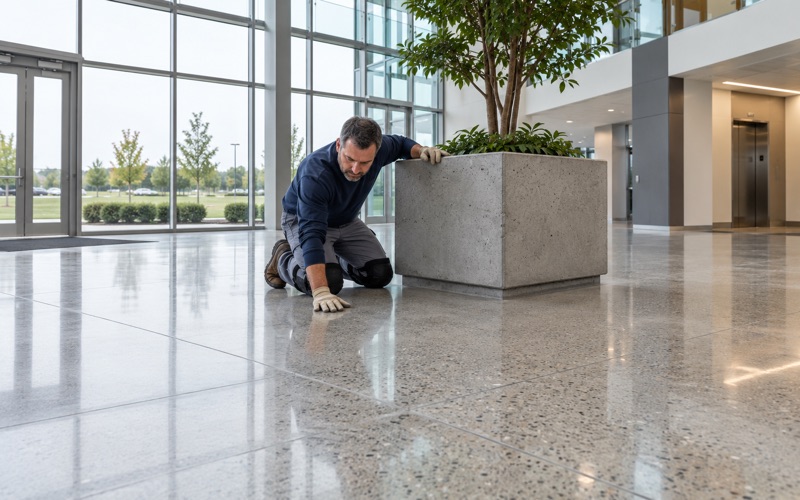
In any lodging building, the guest baths are only part of the floor area. Public rooms such as a ballroom, a dining room or a bowling center carry their own traffic, furniture loads and look, and the decision there turns on wear and cleaning rather than on the 37.4(1) wording. Some of those rooms are better served by a finish other than resin, and we say so when that is the case.
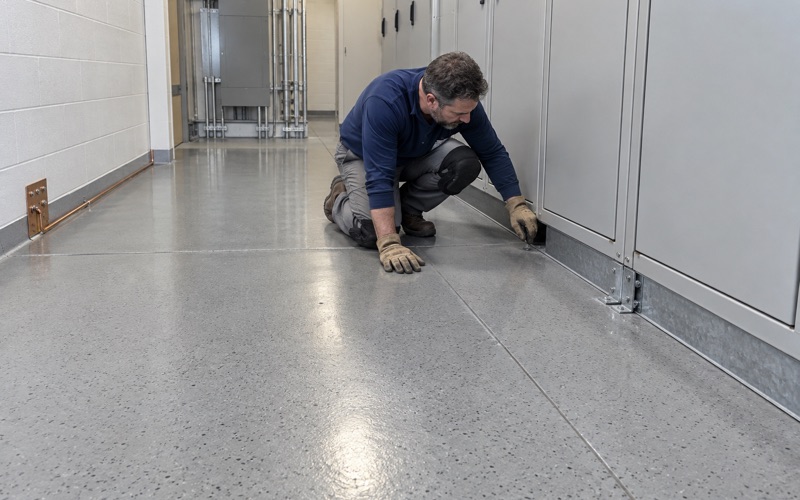
Back-of-house rooms such as housekeeping closets, laundry rooms and service corridors are where a seamless coating often earns its keep. Carts, spilled chemicals and constant mopping punish tile and sheet goods, and a ground, coated slab with a broadcast texture holds up to that routine. A lithium silicate densifier is another option for a bare concrete room that needs dust control more than a sealed surface.
Older Garages Across Town
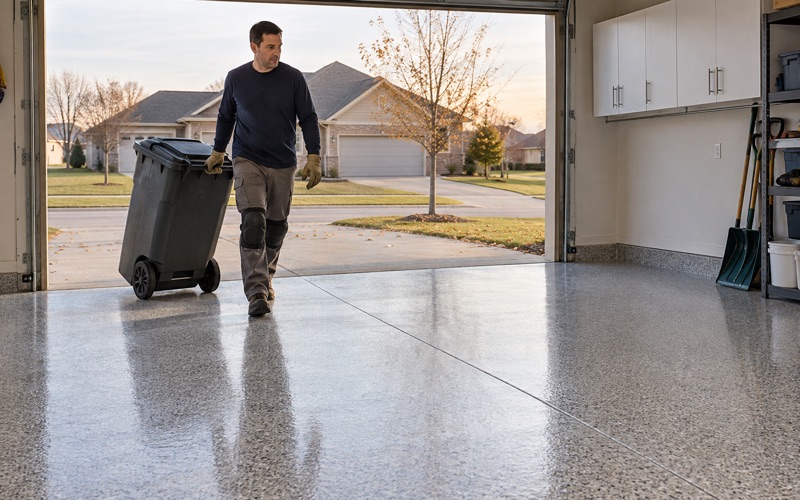
A third of Perry’s homes, 33.5 percent, were built in 1939 or earlier, and most of the housing stock is detached houses. Garages beside those homes range from original slabs to recent pours, and a newer garage is not treated as a safer one: we test the slab whatever year it was poured.
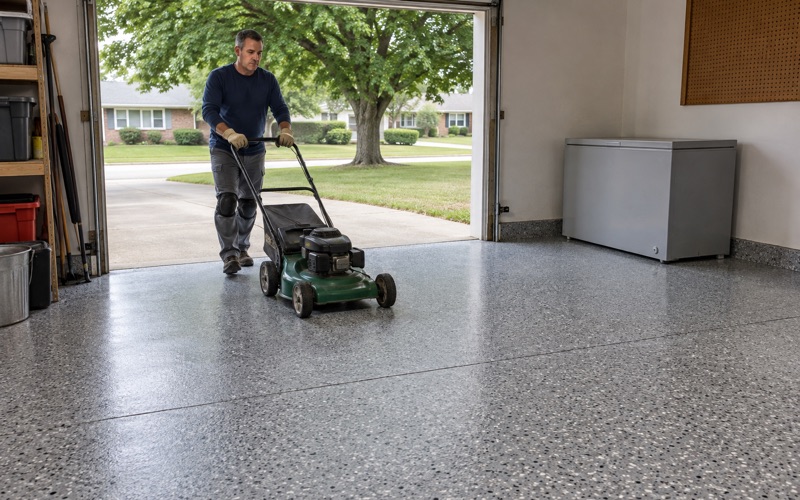
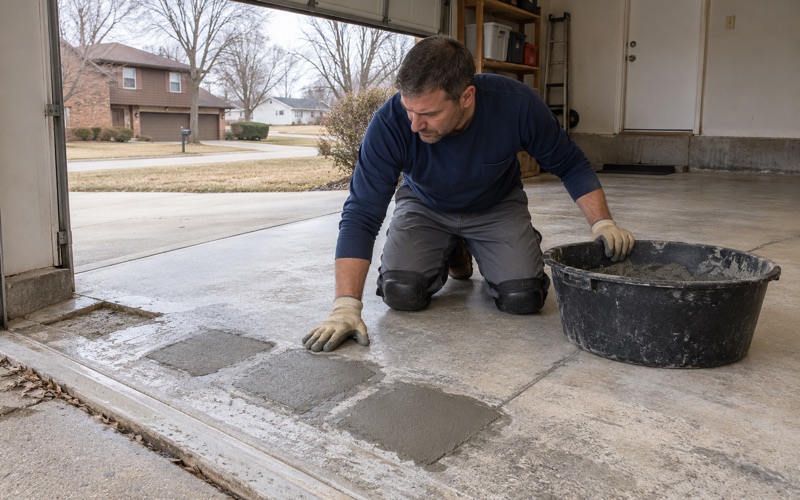
Garage systems are chosen to stand up to the brine and rock salt that ride in on tires from November through March, and to resist hot tire pickup. An unheated garage in a central Iowa winter is told to wait for a proper cure window rather than squeezed onto the schedule. Older slabs often show freeze-thaw scaling near the door, which is ground out and repaired before the base coat goes down.
Basements Read for Water First
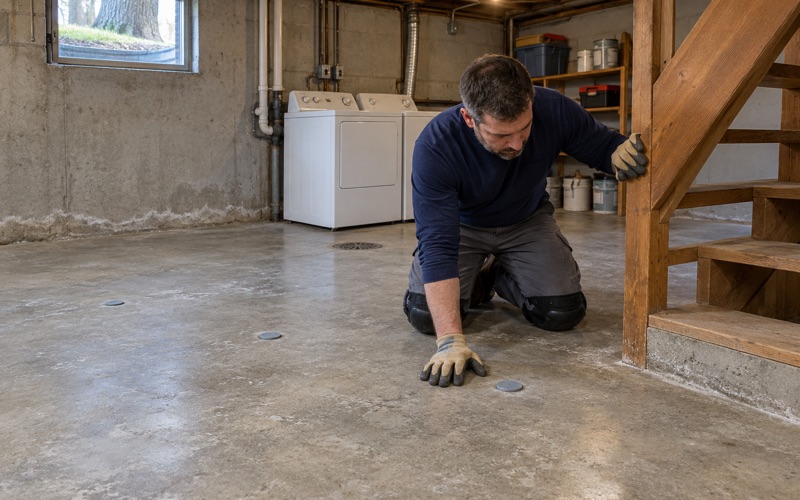
In a basement, we look for past water before anything else, checking the sump pit and drain tile and reading the walls and slab for efflorescence. A coating does not stop seepage or hydrostatic pressure, and we do not sell it as if it did. When a basement shows active water, the drainage problem is solved first and the floor waits until a moisture test says it is ready.
Nor is a floor coating radon work. In Iowa, radon testing and mitigation require a state credential under Iowa Code chapter 136B, so an owner worried about radon is pointed to that process separately, and grinding dust on every job is captured at the machine with a vacuum rather than rinsed toward a floor drain.
- 20+ Years in Epoxy Flooring
- Moisture Tested Before Pricing
- Coats and Thickness in Writing