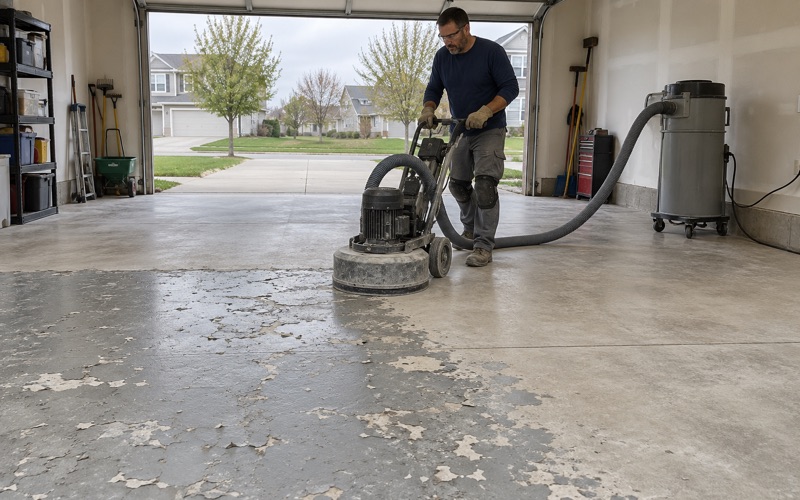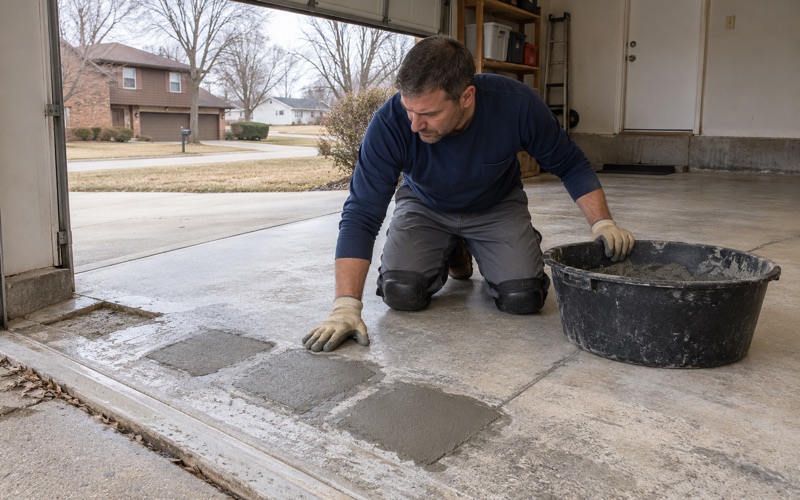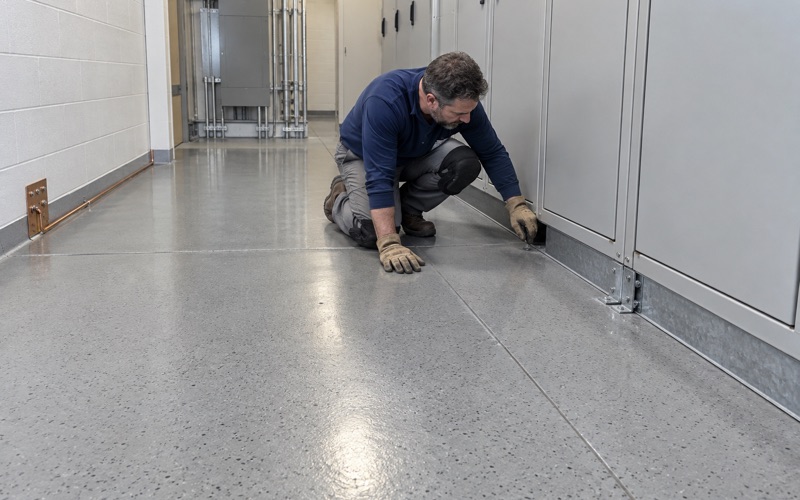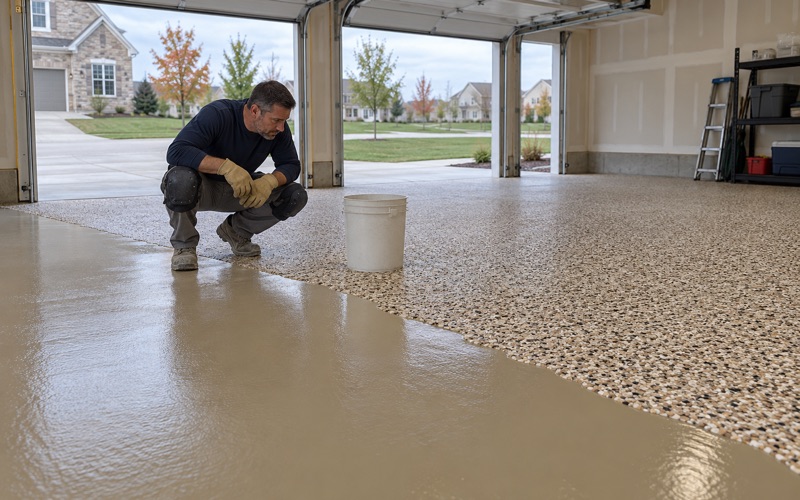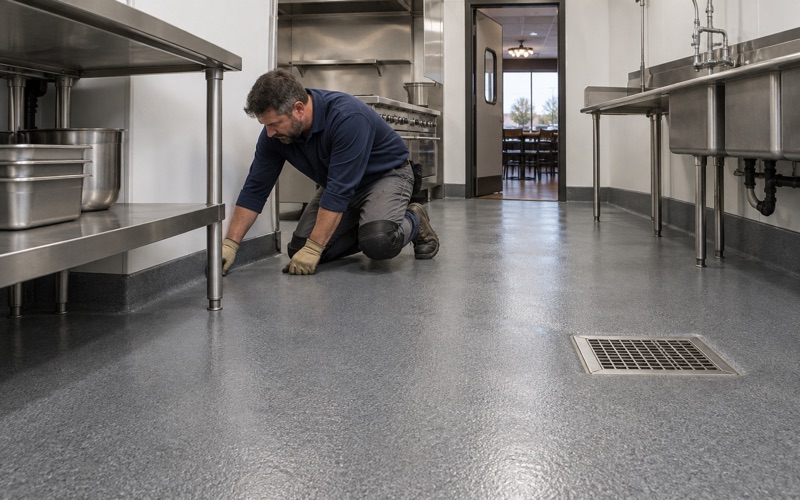
West Des Moines Epoxy Flooring has spent more than 20 years on epoxy flooring in Norwalk and across central Iowa, and the work this page covers happens on a plant floor while the plant keeps running. That means aisle lines, pedestrian walkways and coating repairs, planned in sections so product keeps moving. Every slab we touch is opened with a diamond grinder or a shot blaster first, because a line or patch that peels within a season is just one more hazard on the floor.
Each proposal names the product line, the number of coats and the finished thickness, so a maintenance manager can hold the finished floor up against the paper. Before we price anything, we map the cracks, spalls and failing old coating in the work zone, and we say plainly when a section needs concrete repair before it should take a coating at all.
Moisture testing sits inside the written scope rather than arriving as an afterthought, and cure times are set by slab temperature and dew point instead of the calendar. Those two habits decide whether an aisle stripe outlasts the traffic that runs over it, which is the whole point of the job. A line that lets go at a busy turn has to be redone during the very shifts the plant was trying to protect.
Windsor’s Window Plant and What OSHA Asks of Aisles
A 160,000-square-foot plant on Highway 28
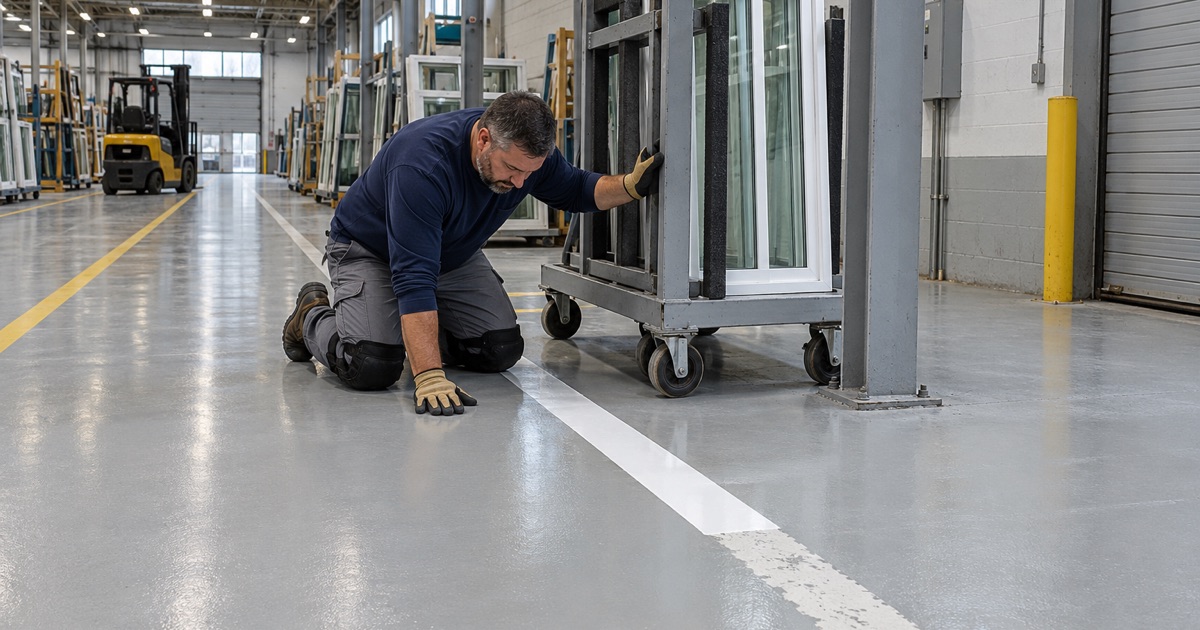
Norwalk is a Warren County city just south of the Des Moines International Airport, and its largest manufacturing floor belongs to Windsor Windows and Doors. The company announced a 160,000-square-foot plant on 27 acres at Highway 28 and Delaware Street in 2017, with construction scheduled to begin that July on a site selected through the IEDA Certified Sites program.
Equipment moved in during early 2018, and the building houses production of vinyl windows and patio doors along with a glass line. We have no relationship with Windsor and know nothing about that plant’s floors or markings. We name it because it is the clearest local example of the kind of floor this page is about, where handling equipment and people share the same concrete all shift. Any plant along the Highway 28 corridor with similar traffic faces the same questions about its aisles.
The words in 1910.176
Federal OSHA’s materials-handling rule, 29 CFR 1910.176(a), is short. Where mechanical handling equipment is used, sufficient safe clearances shall be allowed for aisles, aisles and passageways shall be kept clear and in good repair, and permanent aisles and passageways shall be appropriately marked. Two of those three duties land directly on the floor surface, which is why a striping job and a coating repair so often end up in the same work order.
Notice what the text we read does not say. It sets no color, no line width and no paint type, so we never tell a plant that OSHA demands a particular stripe. What counts as appropriately marked is a decision the facility makes for its own traffic, and our job is to put that decision on the floor in a material that holds.
The walking-working surface rule beside it
A companion rule, 29 CFR 1910.22, covers the floor itself. Walking-working surfaces are to be kept clean, orderly and sanitary, free of hazards such as leaks and spills, and inspected regularly and as necessary. Workroom floors are also to be kept, to the extent feasible, in a dry condition, which matters when we choose between a smooth finish and a textured one for a given area.
Section 1910.22(d)(2) adds the part that shapes our scheduling: a hazardous condition is to be corrected or repaired before an employee uses the walking-working surface again. OSHA does not approve or certify floor coatings or the contractors who apply them, so what we offer is workmanship and a written scope, not a stamp.
Looking for epoxy-flooring closer to Grimes? See Grimes Epoxy-Flooring.
Aisle Lines and Walkways That Wear as Hard as the Floor
Why painted stripes fail first
A stripe rolled straight onto smooth, sealed concrete is held on by little more than a surface film. Wheels, pallets and dragged product scuff it within weeks at the turns, and a faded aisle edge stops telling anyone where the lane ends. Restriping the same worn lanes every few months costs more in lost floor time than doing the prep once.
We treat a line as a narrow floor. The band is ground to a measured ICRI concrete surface profile, vacuumed clean, and coated with a 100% solids epoxy or a polyaspartic topcoat chosen for the traffic in that lane, so the stripe and the slab around it wear at a similar rate. Edges are cut clean before coating, because a ragged edge is where traffic starts lifting a line.
Pedestrian walkways beside equipment routes
A walkway that runs alongside a vehicle aisle does a different job than the aisle itself. Its edges tell a person where to stand and walk, so the boundary lines need to stay crisp, and the walkway surface often benefits from texture where floors can get wet or dusty.
Slip resistance is something we specify, not something we promise. The broadcast aggregate, usually quartz, and the topcoat locked over it set the texture, and the proposal states both so the plant can see exactly what went down and match it later. Colors and widths for walkways and aisles are the facility’s call, and we apply the layout its own safety staff settles on.
Matching new lines to the coating around them
Where a plant floor is already coated, a new line has to bond to that coating rather than sit on top of it. We check adhesion on a small test area, abrade the old surface, and watch for amine blush on recently applied epoxy, which leaves a waxy film the next coat will not grip.
Where old coating is failing, we map it first and say so. Laying fresh lines over a delaminating floor means paying twice, and the honest answer is sometimes to remove a section down to sound concrete before any marking goes back.
Repairing a Damaged Section Before the Shift Walks on It
Reading the damage
Wear on a production floor tends to concentrate: chipped coating at a dock door, a spalled patch where a load was dropped, a cracked edge along a lane every cart crosses. We walk the floor with the facility’s own people, mark each defect, and note which ones sit inside a marked aisle or walkway.
That map becomes the repair scope. It lists each location, the repair method and the material, so nothing depends on memory when a crew comes back on a later shift. It also lets the plant rank repairs, putting a broken edge in a busy walkway ahead of cosmetic wear in a corner nobody crosses.
Fast-return materials for short windows
The repair rule turns on timing, because a damaged surface is supposed to be fixed before people use it again. For that reason we lean on materials that return to service quickly, such as polyaspartic topcoats, and on urethane cement where a section needs a heavier build. The proposal states which one goes where and the finished thickness of each, so the repaired spots can be checked against the quote.
Fast does not mean skipping the basics. Each patch is ground to profile, cleaned with the dust captured at the machine by a vacuum, and given the cure its slab temperature and dew point spread call for before carts roll across it. Until that cure is reached, the area stays coned off and the plant keeps people on its temporary route.
Moisture before a patch goes down
A coating repair that lifts again within a month usually failed from below. We run moisture testing, such as ASTM F2170 in-situ relative humidity probes or an ASTM D4263 plastic sheet test for a quick read, before committing to a product. Larger areas can also get ASTM F1869 calcium chloride testing, and the results go into the written scope rather than staying in a crew notebook.
If a slab reads too wet for the system planned, we say so and adjust, sometimes with a moisture-mitigation primer. A floor coating does not stop water, and when we explain the warranty, moisture is the first exclusion we name, well before any work is sold.
Phasing Floor Work Around a Running Production Line
Sections, not shutdowns
Most plants cannot close a floor for a week, so we break the work into sections that follow the facility’s own layout. One aisle segment or one walkway run is prepared, coated and cured while traffic moves around it on a temporary route the plant approves. Sections are sized so the remaining aisles can still carry the shift’s material flow without forcing equipment and people into the same narrow lane.
The sequence is written down before we start. Each section carries a start time, a cure window and a return-to-service time, which lets supervisors plan material moves instead of discovering a closed lane in the middle of a shift.
Overnight and weekend windows
Where a line runs during the day, we schedule grinding and coating overnight or across a weekend. Dust capture at the grinder keeps fine concrete powder off finished product and away from floor drains. Nothing is rinsed down, and the area is handed back clean and dry, ready for the first shift to walk in.
Low-odor products are available where a neighboring area stays occupied, and we offer them as a comfort choice rather than as something Iowa law requires. The product data goes into the proposal so the plant’s safety staff can review it ahead of time.
Planning around Norwalk’s ground and codes
Norwalk sits on a dissected till plain beyond where the Des Moines Lobe ended, and its mapped soils range from well-drained Shelby clay loams to poorly drained silty clay loams within a short distance. That variety is one more reason we test each slab instead of assuming a building of any age is dry.
For commercial work, Norwalk finalized its adoption of the 2021 International Building Code and International Fire Code on September 26, 2024. Whenever a project might touch a permit, we point owners to the Community Development Building Department at 705 North Avenue or 515-981-9530 before work is scheduled. We do not guess at permit status for floor work, since the city is the one that decides it.
- 20+ Years in Epoxy Flooring
- Moisture Tested Before Pricing
- Coats and Thickness in Writing