West Des Moines Epoxy Flooring brings more than 20 years of epoxy-flooring work to Huxley, and the floors that shape our planning here are working shop slabs with heat running through them. A heated floor is a comfortable place to work through an Iowa winter, but it also hides plastic tubing inside the concrete, and every tool we bring to a coating job cuts, grinds or drills into that concrete.
So the order of our work changes on a radiant slab. We find out where the tubing runs before a grinder touches the surface, we decide how deep the preparation can safely go, and we agree with the owner on when the heat goes off and for how long. None of that is guesswork we leave to the day of the job.
The rest of our process stays the same as it is on any slab. Every floor is opened mechanically with a diamond grinder or shot blaster, never acid, moisture is tested as a written line in the scope, and the proposal states the product, the coat count and the finished thickness you can hold us to.
Contractor Condos With Heated Floors at Huxley Business Park
What the Listings Describe
Huxley Business Park sits about two miles off I-35, and its building at 401 Snyder Drive is being marketed as six contractor condo units on a 6.41-acre lot. The listings describe bays of about 1,650 square feet with a 14-by-14 overhead door, LED lighting, roughed-in plumbing for a future restroom, a 6-inch reinforced concrete slab and radiant heat. Some units are offered for sale and others for lease, and the park is pitched at contractors and small businesses.
We read those listings the way any buyer should, as marketing rather than as-built records. One aggregator lists the HVAC as none, and the build year differs from one listing to the next, so we confirm what is actually in a given bay before we price it. We have no connection to the park’s owner or its brokers; we work for whoever owns or leases the unit.
Why a Heated Bay Changes the Prep
A 1,650-square-foot bay with a big door takes the same punishment as any contractor shop: trailers, jack stands, dropped tools, and brine and rock salt riding in on tires from November through March. Those are the conditions we choose a coating system for, and they are no different in a heated unit.
What is different is underneath. Radiant heat in a slab means hydronic tubing cast into the concrete, and the preparation a coating needs (grinding, crack routing, a saw cut at a failed joint, anchors for a lift or a rack) all reach down into that slab. A coating does nothing for the tubing, and nothing about the tubing makes a coating easier, so our job is simply to coat the floor without damaging what is in it.
Looking for epoxy-flooring closer to Clive? See Epoxy-Flooring in Clive.
Where the Tubing Sits and How We Find It
High Tubing Versus Low Tubing
The depth of radiant tubing in a slab is a design choice, not a standard. A June 2015 Amvic technical bulletin, drawing on Rehau’s recommendations, puts the tradeoff plainly: tubing near the bottom of the slab is better protected from drilling and from saw cuts for expansion joints, while tubing near the top responds faster and can produce hot spots. The same bulletin notes a maximum fluid temperature of 140 degrees for radiant tubing in concrete unless otherwise approved.
That means two bays that look identical from the doorway can carry their tubing at very different depths. We do not know where the tubing sits in any particular Huxley unit until we check, and we will not assume it is deep because a slab is listed at six inches thick.
As-Built Drawings Come First
The cheapest way to find tubing is on paper. If the owner, the developer or the heating installer can produce as-built drawings or layout photos taken before the pour, they usually show loop spacing, the manifold location and where runs cross doorways and joints.
We treat a drawing as a strong guide rather than a guarantee, since field changes do not always make it back to the plans. Where a drawing exists, we compare it with what we see on the floor, such as the manifold position and any visible joint layout, before we rely on it.
A Thermal Scan With the Heat Running
When there are no drawings, or the drawings and the floor disagree, a thermal scan is the practical answer. With the heat running, warm water in the loops shows up as warmer bands on the slab surface, and those bands can be marked directly on the concrete with chalk or paint.
The scan has to happen while the system is on, which is why it comes before the heat shutdown and not after. Once the layout is marked, it stays on the floor through the whole job, and every crew member doing a cut or setting an anchor works from those marks.
Cutting Into a Heated Slab, Then Shutting the Heat Down
Grinding Depth and Crack Routing
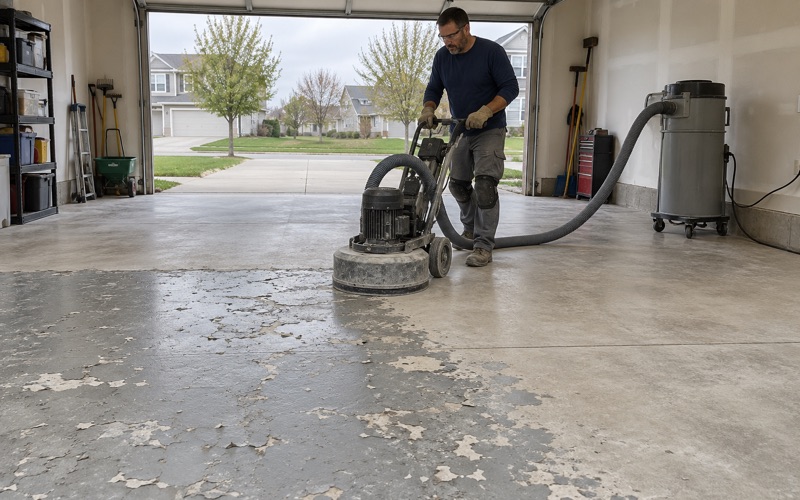
Most resin systems need a concrete surface profile in a modest range. Sika’s epoxy application guide, for example, calls for preparation with a shot blaster or grinder to a profile equivalent to ICRI CSP 3, with paint, sealers, curing agents, laitance and oils removed and all residue vacuumed. That is surface work, measured in fractions of an inch, and on a typical slab it is nowhere near the tubing.
The risk rises when a floor needs more than a surface profile. Taking down a high spot, removing a thick old coating or routing a crack opens the concrete deeper, and on a slab with high-set tubing we keep that work shallow and confirm the layout first. Cracks, spalls and old coatings are mapped before we quote, and if a heated slab needs repair beyond what a coating crew should do, we say so in writing.
Saw Cuts and Anchors
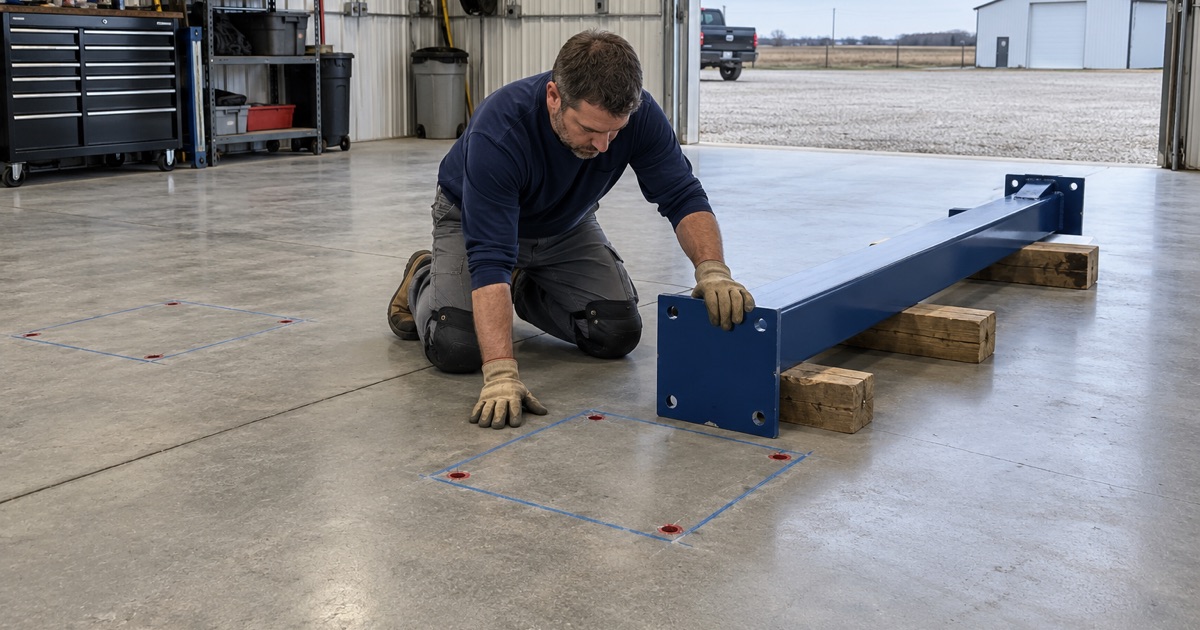
Saw cuts and drilled anchors are where tubing damage usually happens, because they go straight down. Before we cut a control joint, rout a failed joint or drill for a vehicle lift, a shelving system or a bench, we check the hole or cut line against the marked layout and move it when it crosses a loop.
We do not repair radiant heating systems, and a coating cannot seal or fix a nicked loop. That is why the locating step is not optional on these floors, and why we coordinate anchor locations with the owner before the coating goes down rather than after. Every grinder and saw we run is also connected to a vacuum, so dust is captured at the machine instead of being hosed toward a floor drain, which keeps the chalked layout visible through the whole job.
Why the Slab Has to Come Into Range
Resin coatings are applied within a temperature window set by the manufacturer, and a heated slab can sit outside it. Sika’s guide, as one example, asks for concrete of at least 50 degrees and at least 5.5 degrees above the dew point, and every product data sheet also sets a practical upper limit, because a warm slab shortens working time and can push air out of the concrete into wet resin.
So once the tubing is located, the heat is turned off and the slab is given time to settle into the range for the product we have specified. We check slab temperature and dew point at the surface on the day, and our cure schedule follows those readings rather than the calendar.
Planning the Shutdown With the Owner
A bay with its heat off in a central Iowa winter is a cold room, and that can push a job the other way, below the minimum. We plan the shutdown with the owner so the slab cools enough without dropping too far, and if the weather will not allow both, we tell you to wait rather than coat out of range.
We also agree on when the heat can come back on. Bringing a radiant floor up too soon after coating stresses a fresh film, so the restart is part of the written schedule, not something left to whoever is in the shop that morning.
Moisture Still Gets Tested
The ground under Huxley is glacial till on the Bemis moraine, where well-drained Clarion loam sits beside poorly drained Webster clay loam, with a seasonal water table as shallow as 15 centimeters in the soil survey. A heated slab is not a dry slab by definition, and a new building is not either.
We test moisture on every floor, using ASTM F2170 in-situ relative humidity probes or ASTM F1869 calcium chloride tests as the product requires, and the result goes into the scope before the price is final. Moisture is also the first exclusion we explain in any coating warranty, and a coating is never sold as a fix for it.
Shop-Floor Systems for Small Contractor Bays
Matching the System to the Work
For most contractor bays we recommend a 100% solids epoxy base with a vinyl flake or quartz aggregate broadcast and a polyaspartic or polyurea topcoat. That combination stands up to rolling loads, dropped tools and hot tire pickup, and the broadcast and topcoat together set the slip resistance, which we specify rather than promise.
Where a shop runs hotter fluids, heavier equipment or frequent washdowns, a urethane cement system can make more sense. The proposal names the product line, the number of coats and the finished thickness either way, so the floor can be checked against the quote.
Scheduling Around a Working Shop
A contractor who owns or leases one of these units usually cannot close for long. We phase the prep, locating and coating to fit the shutdown window and the owner’s schedule, using evenings and weekends where the work allows.
Huxley is a city of a little over 4,000 people in Story County, part of the Ames metro area, and its business park is close enough to I-35 that our crews reach it easily. What decides the timeline is the slab, not the drive: tubing found, heat off, temperature and moisture in range, then the coating.
- 20+ Years in Epoxy Flooring
- Moisture Tested Before Pricing
- Coats and Thickness in Writing