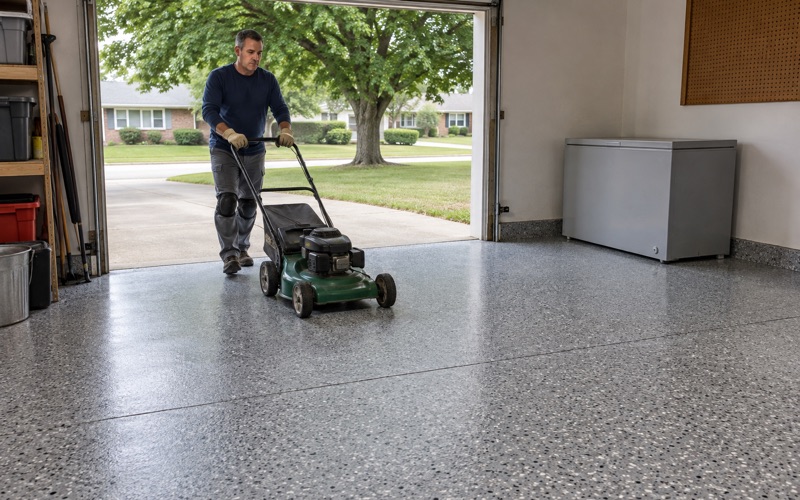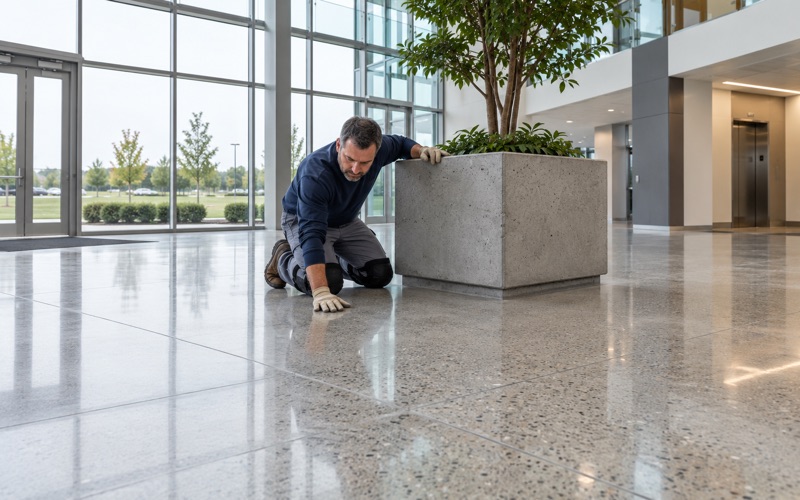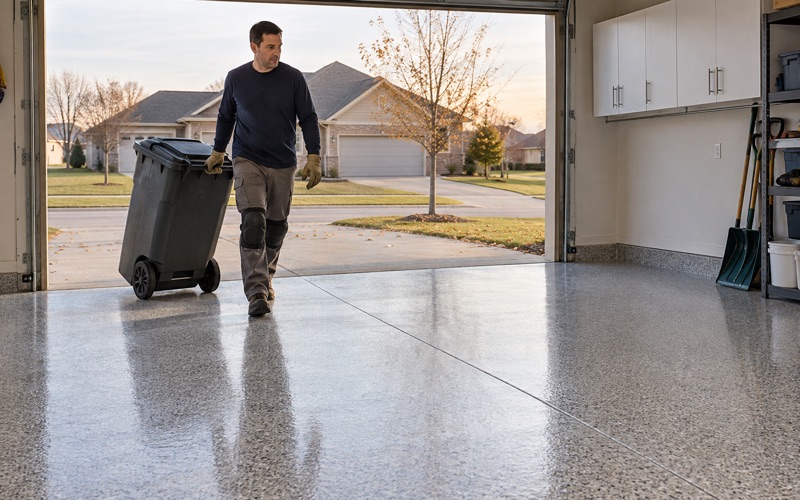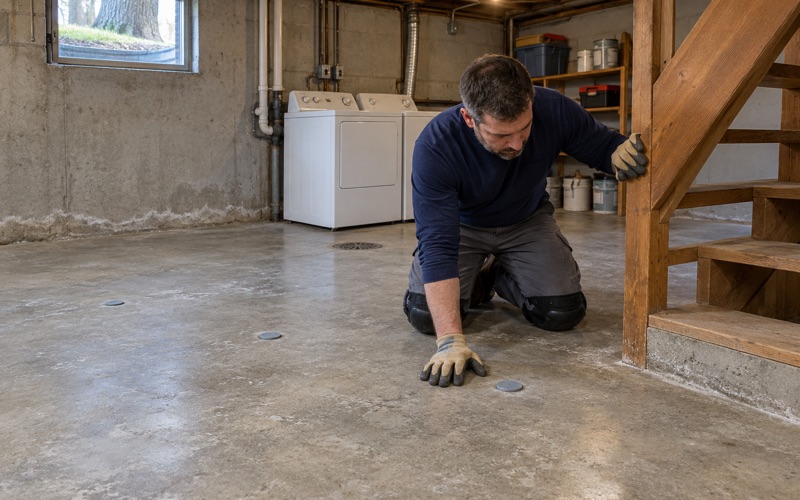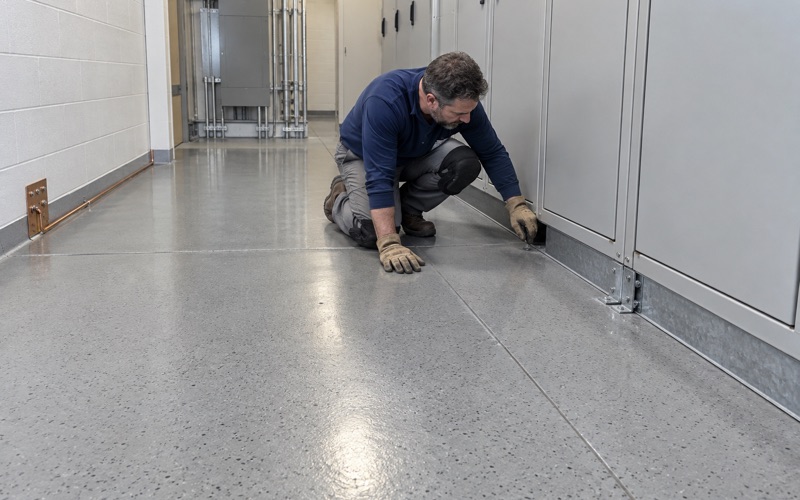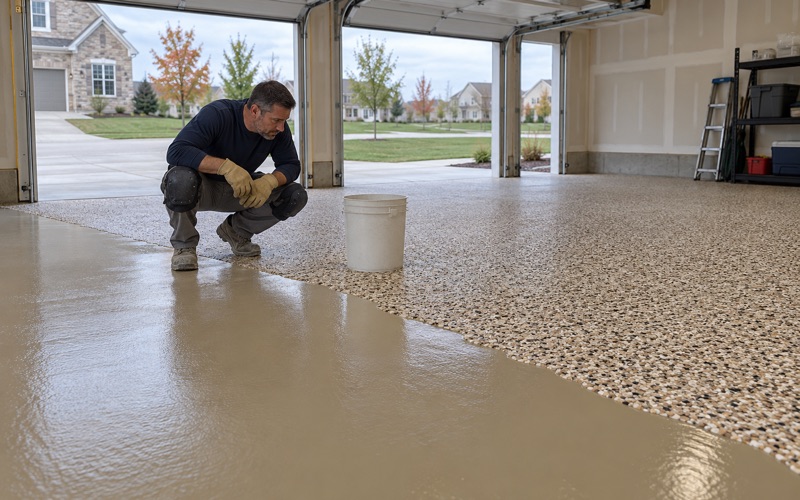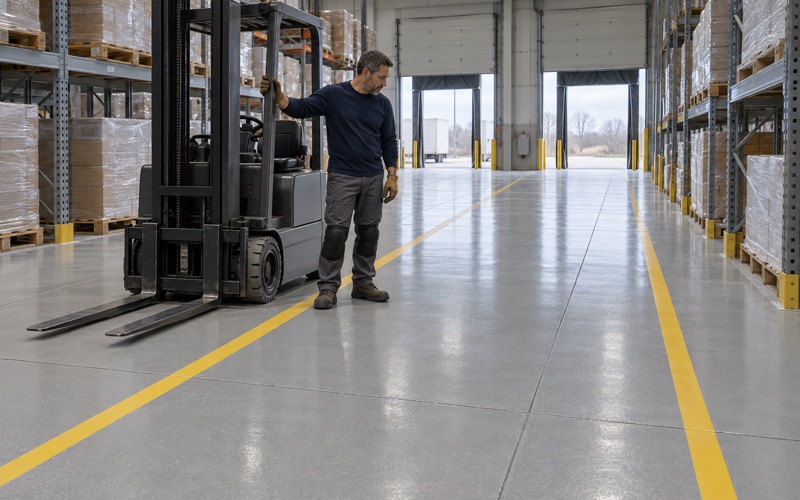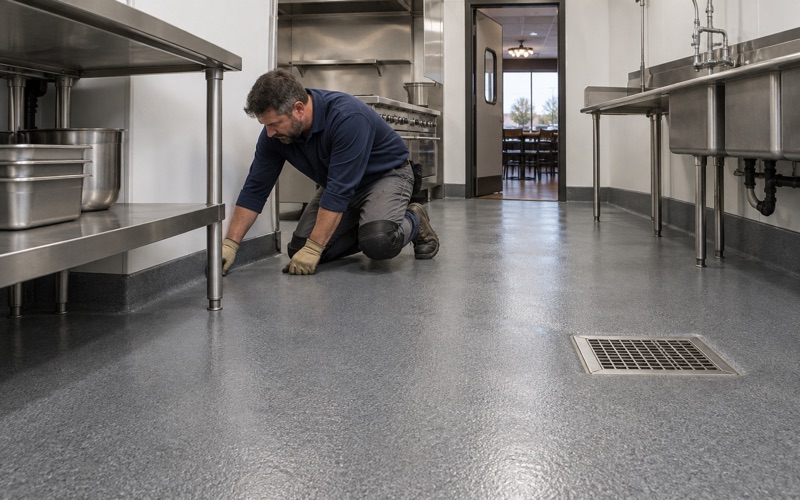
West Des Moines Epoxy Flooring has spent more than 20 years on epoxy flooring, and in Grimes our work starts with the slab rather than the color chart. Before any resin goes down, we open the concrete with a diamond grinder or a shot blaster, so the first coat has a real profile to bite into instead of an acid-etched skin that may or may not hold.
That habit matters most where a floor works hard. Shops, garages and warehouse bays each ask something different of a coating, and the right system depends on what lands on the floor, how often it gets swept and what walks or rolls across it. Every proposal we write names the product line, the number of coats and the finished thickness, so the floor you get can be checked against the quote you signed.
Moisture testing sits inside that written scope before the price is final, whether the slab is under a house finished last year or one built decades ago. If cracks, spalls or a failing old coating mean the concrete needs repair or replacement first, we tell you that before anyone talks about color.
Fabrication, Blasting and the Floor Around It
Sprayers built on SE Capitol Circle
Grimes is a city in Polk and Dallas counties and part of the Des Moines-West Des Moines metropolitan area, and it builds farm equipment as well as storing it. Sprayer Specialties, headquartered at 4151 SE Capitol Circle, says it builds many of the sprayers and liquid transfer units it sells in-house at its Grimes location, with its own fabrication, blasting and welding teams.
The company was founded in 1976 in a two-car garage in Urbandale and now sells sprayers, nozzles, pumps, tanks and controllers to agricultural, turf, industrial and winter-management buyers. It also runs powder coating and media blasting for prep and finish work. We have no relationship with the company. We name it because it shows the kind of work done on the city’s industrial side, and that kind of work sets the terms for a floor.
What abrasive blasting means under the federal rule
The federal standard at 29 CFR 1910.94(a) defines abrasive blasting as the forcible application of an abrasive to a surface by pneumatic pressure, hydraulic pressure or centrifugal force. The abrasive is any solid substance used in that operation, and a blast cleaning room is a complete enclosure in which the operator works inside the room.
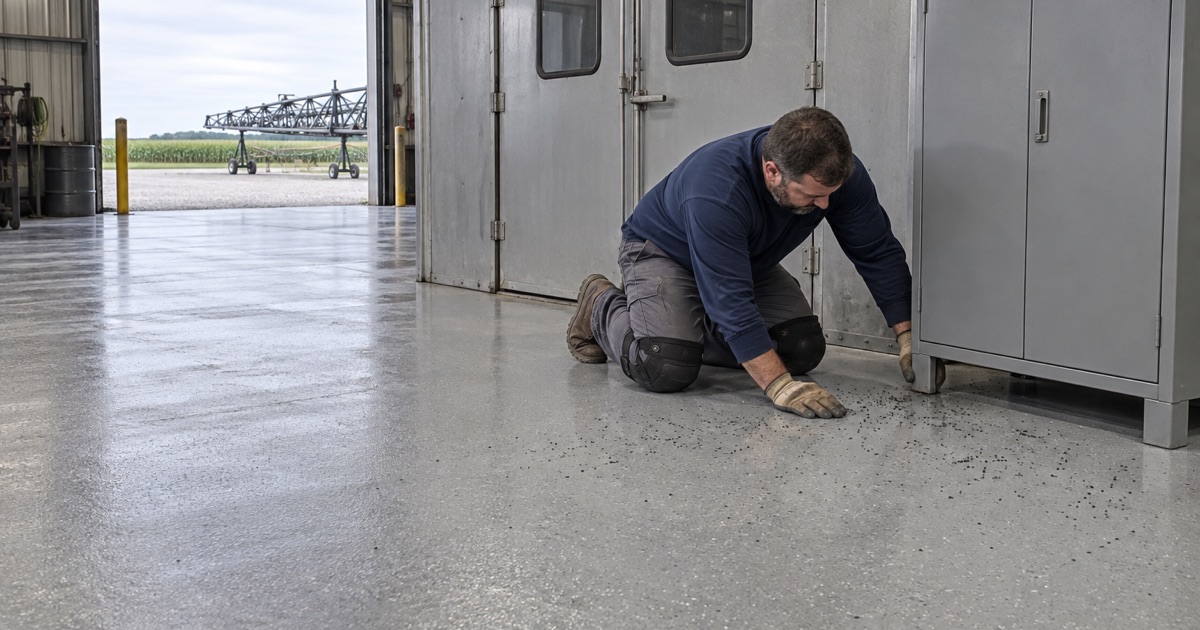
The enclosure exists to keep the media in. In any shop that blasts parts, though, shot and dust can leave on boots, on parts carried out to the next station and through doors that open many times a shift. The floor just outside the abrasive-blasting enclosure is where whatever escapes comes to rest, and it is the floor the rule turns to next.
The housekeeping lines that touch the floor
Two sentences in the standard speak directly to that floor. Dust shall not be permitted to accumulate on the floor or on ledges outside of an abrasive-blasting enclosure, and dust spills shall be cleaned up promptly. Aisles and walkways shall be kept clear of steel shot or similar abrasive which may create a slipping hazard.
Neither line mentions a coating, and no floor finish carries any federal approval under them. What the rule asks for is housekeeping: media found and removed before it builds up. A floor can make that job easier or harder, and that is the part of the problem a coating contractor can honestly help with.
Looking for garage floor coating closer to Des Moines? See Garage Floor Coating in Des Moines.
Steel Shot Underfoot Is a Slipping Hazard
Why loose abrasive behaves like ball bearings
Steel shot is small, hard and round, and on a smooth surface it rolls. A few pieces under a boot heel can shift a footing the way spilled marbles would, and angular grit does much the same once it gathers into a thin layer. That is why the standard names steel shot or similar abrasive in aisles and walkways rather than leaving it to a general cleanliness clause.
A textured coating does not change the physics of a loose ball sitting on top of it. We never describe any floor as safe to walk on with shot scattered across it, and we never suggest a coating can stand in for the blast enclosure or for prompt cleanup. The floor’s job is to support the cleanup, not to excuse anyone from it.
Bare concrete hides what a coating shows
Uncoated concrete in a fabrication bay is usually gray, dusty and porous, and blasting dust settles into almost the same tone. Spent media lodged in a broom-finished slab sits down in the texture and disappears until somebody steps on it.
A sealed, solid-color floor changes that. Contrast between the surface and the abrasive makes a spill visible from across the bay, which is the first step toward cleaning it up promptly. We help choose a color against the media actually in use, because dark steel shot and pale glass bead read very differently on the same floor. A mid-tone that shows both is often the practical answer where a shop runs more than one media.
Dust that stays on the surface
Porous concrete pulls fine dust into its pores and releases it again under traffic, so a bay can look swept and still be shedding. A 100% solids epoxy body coat closes that surface, leaving dust on top where a broom or a vacuum can lift it in one pass. On an older slab that has been dusting for years, a lithium silicate densifier is no substitute here, because it hardens the surface without giving it a film that shows what lands on it.
Sealing the slab also stops the concrete from dusting on its own. What shows up on the floor after a shift is then mostly what came out of the work itself, which makes it far easier to judge at a glance whether housekeeping is keeping up or falling behind.
A Floor That Shows Spilled Media and Sweeps Clean
Texture without grit traps
Slip resistance and cleanability pull against each other. A heavy aggregate broadcast gives boots more bite when the floor is wet or oily, but deep texture also holds fine abrasive in its valleys, where a broom rides over the peaks and leaves the media behind.
We specify texture by the broadcast and the topcoat, not as a promise in a brochure. Near blasting, that often means a fine quartz aggregate broadcast locked down with enough topcoat to round the peaks, so the surface keeps some grip without turning into a place for grit to hide. Wet areas or oily welding bays may justify a coarser grade, and we mark those zones on the plan rather than texturing the whole floor alike.
Solid color over flake where media collects
Vinyl flake broadcast is popular in home garages because it camouflages dirt, and that is exactly the wrong trait beside a blast room. A busy flake pattern hides scattered shot as well as it hides tire marks, so the spill nobody sees is the spill nobody sweeps.
Media also tends to gather along walls, under benches and at door thresholds. A continuous body coat carried tight to the wall line in one plain color keeps those collection points easy to read, and leaves fewer seams and edges for fine dust to pack into between cleanings. Flake still has a place in an office or a showroom on the same property, where hiding everyday dirt is the point.
Preparing a shop slab before any coat
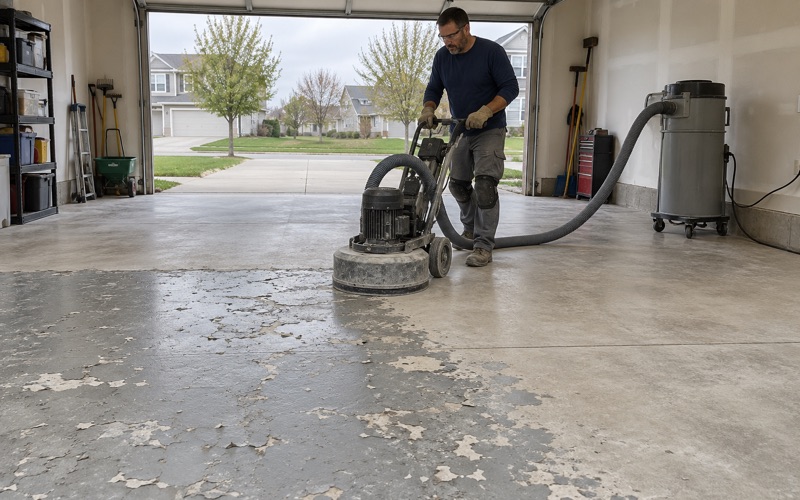
Shop floors carry oil, cutting fluid and years of ground-in dirt. We grind or shot blast to a profile on the ICRI concrete surface profile scale that suits the chosen system, and the dust from our own grinding is captured at the machine with a vacuum rather than rinsed toward a floor drain.
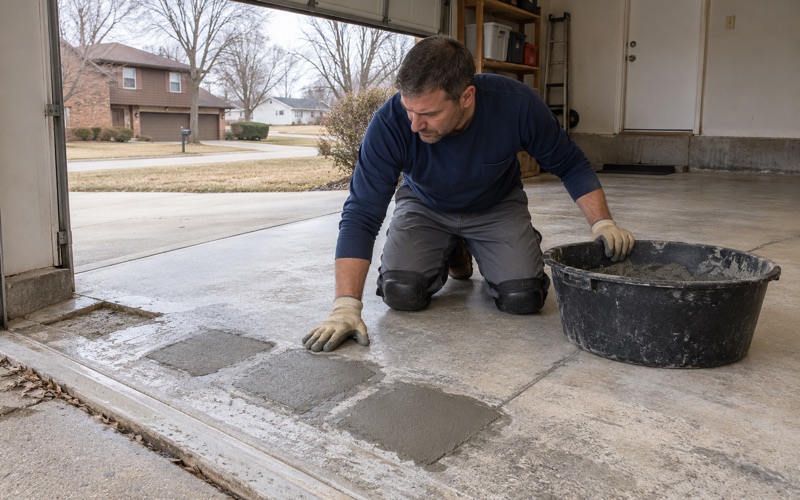
Cracks, spalls and old coatings are mapped before the price is set, and a moisture test, such as ASTM F2170 relative humidity probes, is written into the same scope. Where the slab is too far gone to coat well, we say so plainly and recommend the repair first.
Grit Wear: Texture and Wear Layer for a Blasting Shop
What grit does to a coating over time
Abrasive that escapes the enclosure keeps working after it lands. Ground under boot soles and dragged by carts, it acts like loose sandpaper on whatever surface lies beneath it, and over months it dulls a glossy topcoat and thins the film along the busiest paths.
That wear concentrates where traffic concentrates, at doorways and along the routes parts travel between stations. A floor that looks fine in a quiet corner can be worn through at the threshold, so we plan the system around the heaviest path rather than the average square foot. Walking the floor with whoever runs the shop, before we write the scope, is how those paths get found.
Building the wear layer
For a blasting shop we build thickness where it counts: a 100% solids epoxy body coat for mass, then a polyaspartic or urethane topcoat chosen for abrasion resistance over gloss. The proposal states the finished thickness, so you can measure what was promised against what was installed.
We also plan for the topcoat to be the part that wears. A sacrificial top layer can be scuffed and recoated before grit reaches the body coat, which costs far less than replacing a floor that was worn down to bare concrete along its main aisle. Where the grit load is severe and the floor also sees heat or harsh washdown, urethane cement is worth weighing as a tougher base, and we price both options side by side.
Curing around a working shop
A fabrication floor rarely gets to close for a week. We phase the work around business hours, using overnight and weekend windows when a bay cannot stop, and we keep each section out of service until it has cured hard enough to take boots, carts and grit. Blasting next to a curing floor is a poor mix, so we agree in writing when nearby work pauses.
Cure schedules follow slab temperature and the dew point spread at the slab surface, not the calendar, and an unheated building in a central Iowa winter is told to wait. Before the job is sold we also explain what the coating warranty leaves out, and moisture is the first exclusion we name.
- 20+ Years in Epoxy Flooring
- Moisture Tested Before Pricing
- Coats and Thickness in Writing