
West Des Moines Epoxy Flooring installs epoxy garage floor systems in West Des Moines, IA, serving surrounding cities including Clive, Windsor Heights, Waukee, Urbandale and Norwalk, and we have been working on concrete for more than 20 years. A garage floor here takes salt, slush, hot tires and dropped tools, and the coating only lasts if the slab under it was prepared for that.
So the job starts below the surface. We grind every garage slab with diamond tooling or a shot blaster rather than etching it with acid, test it for moisture, and map its cracks and old coatings before the price is set. The written proposal then states the product line, how many coats go down and the finished thickness, which gives you something concrete to measure the floor against.
What follows is how we think about a garage floor in central Iowa: what the slab is up against, how the system is built, and the order the work happens in.
What a Garage Slab Faces in Central Iowa
Salt brine from November through March
From the first snow to the spring thaw, tires carry calcium chloride and rock salt deicers off the street and into the garage. That brine pools under each car and sits there for weeks. On bare concrete it soaks into the surface, and every freeze and thaw pries a little more of the top layer loose, which is how a slab ends up with the flaking and pitting called freeze-thaw scaling.
A coated floor changes where the brine ends up. It stays on top as a puddle you can squeegee out the door, rather than working its way into the concrete. We choose garage systems with that winter in mind, building enough thickness under the topcoat that salt grit dragged across the floor wears the topcoat, not the concrete.
Hot tire pickup
A tire coming off a hot summer drive is soft and warm when it parks. On a thin or poorly bonded coating, the heat softens the film, and as the tire cools it grips the coating and lifts it off in patches the shape of a tread. That is hot tire pickup, and it is the most common way a store-bought kit fails in its first year.
It is a bond and thickness problem, not bad luck. A slab ground to a real surface profile, a 100% solids epoxy base built to a stated thickness, and a hard topcoat give the tire nothing loose to pull. Before choosing a system, we ask whether your cars spend time on the street in summer or go straight in from a long drive.
Moisture under a garage slab
Codes treat a garage slab differently from the floor of a living space. The IRC R506.2.3 exception lets a garage slab go down without the under-slab vapor retarder a basement or living-space slab would need, so ground moisture can move up through it. A newer house is not a guarantee of a dry garage floor.
We test every garage slab whatever the build year, using ASTM F2170 in-situ relative humidity probes or an ASTM F1869 calcium chloride test, with the ASTM D4263 plastic sheet test as a quick first look. If the readings call for it, a moisture-mitigation primer goes into the scope. Moisture is also the first exclusion we point out in any coating warranty, before you sign.
How We Build an Epoxy Garage Floor System
Grinding to a measured surface profile
The International Concrete Repair Institute describes concrete surface profiles on a scale from CSP 1 to CSP 10. A garage coating needs a profile it can key into, which a garden hose and a jug of acid do not reliably deliver. We use diamond grinding or shot blasting to reach the profile the product line specifies, and we take off laitance, sealers and old coatings in the same pass.
The grinder runs with a vacuum attached, so the dust is collected at the machine rather than drifting into the house or being rinsed toward the driveway and the storm inlet. For an attached garage we also cover the door into the house while we work.
Base coat and vinyl flake broadcast
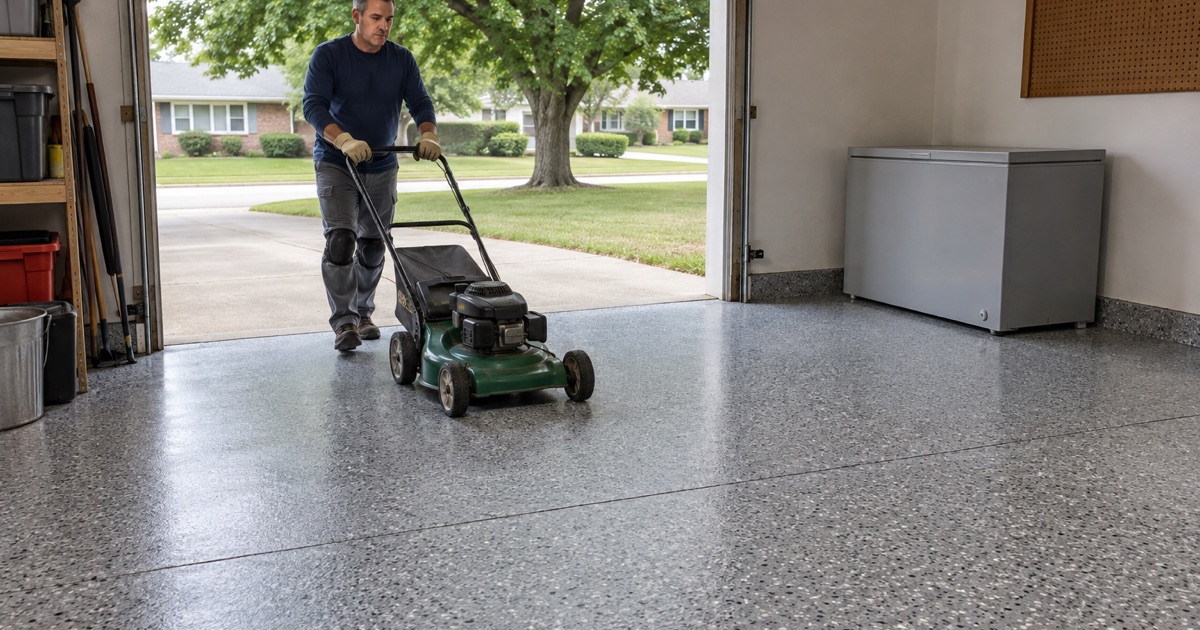
Once cracks and spalls are filled and ground flush, a 100% solids epoxy base coat goes down. While it is still wet, we broadcast vinyl flake into it, usually to full coverage. The flake hides dust and tire marks, adds texture underfoot and spreads wear evenly across the floor.
The blend and the chip size set the look. A fine chip reads like speckled stone, while a larger chip looks bolder and hides more. Once the base has cured, we scrape the loose flake and grind off the high points so the topcoat lays down smooth over a consistent texture.
Polyaspartic topcoat and slip resistance
The topcoat carries most of the daily wear. We usually use a polyaspartic or polyurea topcoat over the flake base because it cures quickly, resists abrasion and holds its color in the sun that comes through an open garage door, where an epoxy topcoat can amber.
Grip is set by the materials, not promised. A full flake broadcast gives some texture by itself, and we can add a fine grit to the topcoat for a garage that sees a lot of snowmelt. We write the texture into the proposal, and we explain that more grip also means a floor that takes a little more effort to clean.
Our Step-by-Step Epoxy Garage Floor Process
Step 1: Walk the slab and map it
We look at the whole floor with you, mark cracks, spalls, pitting and old coatings, and note where water gathers and where the slab meets the house door and the driveway. If the slab is heaved or broken through, we tell you then that it should be repaired or replaced before any coating goes down.
We also ask how the garage is used. A floor that holds two daily drivers, a workshop corner with a rolling tool chest, or a second refrigerator and a freezer each wears differently, and that shapes the flake blend, the topcoat and where extra texture is worth having.
Step 2: Test moisture and write the proposal
Moisture tests are placed and read before we finalize the price. The proposal lists the readings, the primer, the product line, the number of coats and the finished thickness, along with what the warranty does and does not cover.
If the readings are high, you see that before you commit, along with what the mitigation primer adds to the cost. If the slab is too damaged to be worth coating, the proposal says so rather than quietly pricing a floor that will not last.
Step 3: Schedule by slab temperature and dew point
Resin cures by the conditions at the slab surface, not by the calendar. We check slab temperature and the dew point spread before booking. An unheated garage in a central Iowa winter is told to wait, because a cold, damp slab invites amine blush and a weak bond.
Spring and fall are the busiest stretches for garage work, since many slabs are warm enough by then and the salt season is either over or still ahead. A heated garage can be scheduled through the winter as long as the slab readings hold steady on the day.
Step 4: Grind, repair, coat and hand back
On installation day we grind, fill and level, then lay the base coat, flake and topcoat in the order the product line calls for. Low-odor products are available for attached garages as a comfort choice. Before we leave, you get the date when it is safe to drive back in.
After that, care is simple. Rinse the salt and grit out in spring, squeegee standing brine during the winter, and put a mat or a small pad under kickstands and jack stands. A floor that is cleaned a few times a year keeps its texture and its color far longer than one left to sit under a winter of slush.
- 20+ Years in Epoxy Flooring
- Moisture Tested Before Pricing
- Coats and Thickness in Writing