
West Des Moines Epoxy Flooring provides concrete grinding in West Des Moines, IA, serving surrounding cities including Clive, Windsor Heights, Waukee, Urbandale and Norwalk. After more than 20 years of preparing slabs, we see grinding as the step that decides whether a floor lasts, because every coating, sealer and polish depends on the condition of the surface it is bonded to or cut from.
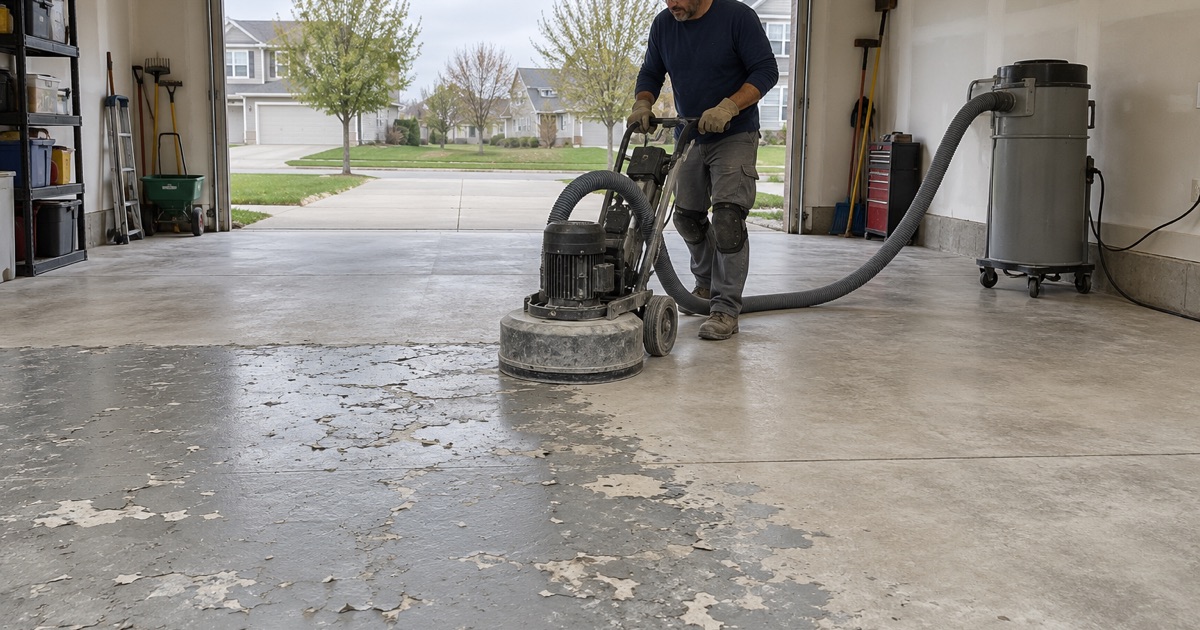
We open concrete with diamond grinders or shot blasting equipment, never with an acid etch. Mechanical preparation removes the weak top layer, old coatings and contamination, and leaves a measurable texture that a new system can grip. Dust is collected at the machine by an attached vacuum rather than being swept, rinsed toward a floor drain or washed out to a storm inlet.
Grinding also tells us what the slab is really like. Once the surface is open, we can see cracks, spalls, soft areas and old patches clearly, and we map them before the final price. If the slab needs repair or replacement before it should be coated, we say so then.
Why Grinding Comes Before Any Coating
A measured surface profile
The International Concrete Repair Institute rates surface texture on a scale from CSP 1, nearly smooth, to CSP 10, very rough. Coating manufacturers specify which profile their products need, and thicker systems generally need a rougher surface. Grinding and blasting let us reach that profile on purpose rather than by chance.
A proper profile gives the coating more surface area and a mechanical key to bond into. Without it, even a high-quality 100% solids epoxy or polyaspartic can peel, because it is only sitting on a smooth, sealed surface. We check the profile as we go and match it to the product named in the proposal.
Laitance, sealers and curing compounds
The top of a concrete slab often carries laitance, a weak, chalky layer of cement paste that forms as the concrete is finished. Many slabs also have curing compounds or sealers applied during construction, which block a coating from bonding.
Grinding removes these layers and exposes sound concrete beneath. A water drop test and a visual check after grinding help us confirm that the surface will accept a primer evenly instead of beading or soaking in patchily.
Why we do not acid etch
Acid etching is common with store-bought kits because it is cheap and easy. It leaves an uneven, often weak surface, does not remove sealers or coatings reliably, and puts acid and rinse water on the floor and into drains.
Mechanical grinding is slower and needs heavier equipment, but it delivers a consistent profile and removes contamination instead of just roughening it. That is why every slab we coat is ground or blasted first.
Diamond Grinding and Shot Blasting
Diamond grinding
Diamond grinders use rotating heads fitted with metal-bonded or resin-bonded diamond tooling. Coarse tooling removes coatings and high spots, while finer tooling refines the surface for coatings or polishing. Edge grinders and hand tools reach along walls, around posts and into corners where large machines cannot go.
Diamond grinding works well in garages, basements and most interior spaces. It also allows us to flatten minor ridges and lippage at joints, which improves the look of the finished floor and reduces trip points.
Shot blasting
Shot blasting throws steel shot at the concrete surface and recovers it in the same machine. It creates an even profile quickly across large open areas, such as warehouses, plant floors and parking decks.
Shot blasting can leave a striped pattern if passes are not overlapped carefully, and it works less well on uneven surfaces. We choose between blasting and grinding, or use both, depending on the floor and the system to be installed.
Dust capture and clean-up
Our grinders and blasters run with industrial vacuums designed for concrete dust. That keeps the air in garages, basements and occupied buildings cleaner and keeps fine silica dust out of mechanical systems.
We do not wash grinding slurry or dust into floor drains, sump pits or storm inlets. Waste is collected and bagged, and the floor is vacuumed before primer goes down.
Removing What Is Already There
Old epoxy, paint and sealers
Many floors already carry a coating, often a thin kit epoxy, garage paint or an old sealer. If it is peeling or poorly bonded, it has to come off. We grind it away completely rather than coating over it, because a new floor is only as strong as the layer beneath.
Thick or well-bonded coatings take more time and more aggressive tooling. We look at the coating during the site visit and price its removal in the proposal so there are no surprises on installation day.
Tile adhesive, carpet glue and mastic
Basements and commercial spaces often have adhesive left from tile, carpet or vinyl flooring. Black mastic, in particular, gums up tooling and takes extra passes to remove.
We grind adhesive down to clean concrete and check for residue before priming. Mastic removal is often a separate line item, since it can add significant time to the job.
High spots, ridges and uneven joints
Slabs can have high spots from finishing, curled edges at joints or ridges where pours meet. Grinding can take these down to improve flatness before a coating or another floor covering.
We set expectations clearly: grinding improves flatness but does not turn a badly sloped slab into a level one. Large dips may need a self-leveling underlayment or patching, and we say so when they do.
Grinding as a Finish of Its Own
Grinding is also the first stage of polished concrete. Coarse passes expose aggregate, a lithium silicate densifier hardens the surface, and finer diamonds bring up the sheen. A ground and densified slab without a full polish can be a durable, low-maintenance finish for storage areas and back rooms.
We also prepare slabs for other trades, removing old adhesive or high spots so another floor covering can be installed. The installer’s product requirements set the target, and we grind to those.
- 20+ Years in Epoxy Flooring
- Moisture Tested Before Pricing
- Coats and Thickness in Writing