
West Des Moines Epoxy Flooring handles concrete floor repair in West Des Moines, IA, serving surrounding cities including Clive, Windsor Heights, Waukee, Urbandale and Norwalk. With more than 20 years on slabs, we treat repair as part of any good floor rather than a separate trade, because a coating laid over broken concrete only hides the problem for a season before it comes back through.
Every repair job starts with a map. We walk the slab, mark cracks, spalls, pitting, scaled areas, broken joints and old patches, and decide which ones can be repaired and which point to a deeper problem. That map goes into the written proposal along with the repair materials we plan to use.
We are also direct about the limits. Some slabs are too far gone to be worth repairing and coating, whether from heaving, severe settlement or damage that runs through most of the floor. When that is the case, we say plainly that the slab should be replaced rather than coated, even when it means we do not get the coating job.
Cracks: Static or Still Moving
Hairline and shrinkage cracks
Most slabs develop fine cracks as the concrete dries and shrinks. These are usually stable and shallow. We clean them out, fill them with a repair material suited to the coating that will follow, and grind the filled crack flush so it disappears under the new system.
Hairline cracks are not a sign that the slab is failing. They are a normal part of concrete, and they are easy to deal with during surface preparation. We still note them on the map so you know they were there and how they were treated.
Wider and moving cracks
Wider cracks, cracks with uneven edges and cracks that open and close with the seasons need more attention. A crack that is still moving will reflect through a rigid coating, so we may route it, fill it with a flexible material, or recommend leaving it as a joint in the finished floor.
When a crack shows vertical displacement, where one side sits higher than the other, the slab has moved. Grinding can reduce a small step, but larger offsets can indicate settlement or heaving, and those deserve a closer look before any repair is chosen.
Spalls, Pitting and Salt Scaling
Spalled edges and broken joints
Spalls are chips and broken pieces at the edges of joints and cracks, often caused by wheels, forklifts or dropped loads. Left alone, they widen and collect debris. We cut back to sound concrete, rebuild the edge with a repair mortar and re-establish the joint where it is needed.
In commercial and warehouse floors, joint repair matters for more than looks. Broken joints rattle carts and forklifts, wear tires and shake loads. Repairing them before coating or polishing makes the finished floor smoother and longer-lasting.
Pitting and surface damage
Pitting can come from poor finishing, aggregate popping out near the surface or wear over many years. Shallow pits are filled and ground flush during preparation, while widespread pitting may call for a skim coat before the coating system.
The repair material is chosen to work with the system on top. A patch that bonds well with an epoxy primer may not suit a polished finish, so we match repair products to the final floor rather than using one filler everywhere.
Freeze-thaw scaling from deicers
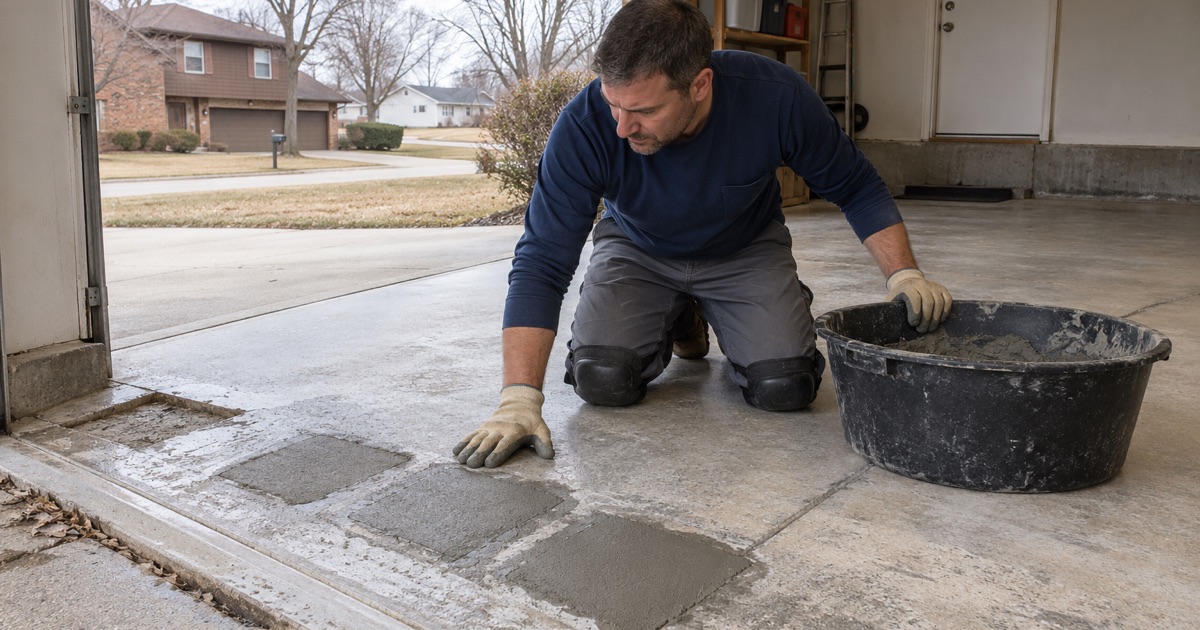
Garage slabs in central Iowa take a beating from calcium chloride and rock salt that ride in on tires every winter. Brine soaks into the surface, freezes and thaws, and gradually flakes off the top of the slab. The result is a rough, scaled surface around where vehicles park.
Where scaling is shallow, we grind off the loose concrete, rebuild low areas with a repair mortar and coat the floor so salt stays on top from then on. Where the scaling is deep or widespread, replacing the slab may be the better investment, and we explain that clearly.
Repair or Replace
When repair makes sense
Repair is a good choice when the slab is structurally sound and the damage is limited to surface wear, static cracks, joint edges or isolated spalls. In these cases, repair and a new coating can give a floor many more years of service at a fraction of the cost of replacement.
We price repairs as clearly as the coating itself, so you can see how much of the job is fixing the slab and how much is finishing it. Each repair is tied to a spot on the slab map, so the line items match what you can see on the floor.
When replacement is the better answer
Some slabs have heaved, settled unevenly, cracked through in many directions or scaled so deeply that most of the floor would need patching. Coating these floors is a short-term fix at best.
In those cases we recommend replacement before any coating, and we can coat the new slab once it has cured and tested dry. Being direct about this up front saves you from paying twice for a floor that was never going to hold.
Testing Before Repair
Moisture affects repair materials as much as coatings. Before patching a basement or garage slab, we test moisture with ASTM F2170 relative humidity probes or an ASTM F1869 calcium chloride test, and we look for efflorescence and signs of past water.
If moisture is high, the repair and coating plan may change to include a moisture-mitigation primer or to address a drainage problem first. Those results and the plan that follows from them are written into the proposal before the price is final.
- 20+ Years in Epoxy Flooring
- Moisture Tested Before Pricing
- Coats and Thickness in Writing