West Des Moines Epoxy Flooring has put more than 20 years into concrete coatings, and our epoxy flooring in Clive increasingly starts with a floor that sees more chemistry than traffic: the beauty studio. A garage takes tires and road salt. A salon floor takes hair color, lightener, nail solvent and a broom pass after every client, and it is judged by a state rule as well as by the owner’s eye.
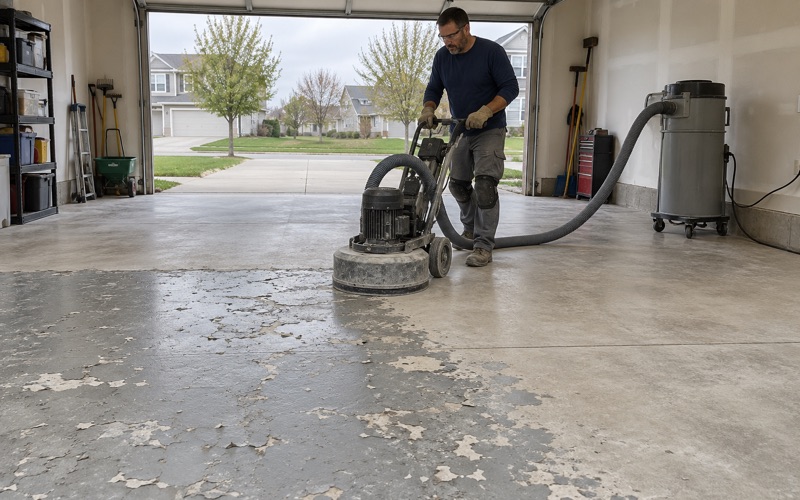
That changes what goes into our proposal. We name the product line, the number of coats and the finished thickness in writing, so a studio owner can hold the finished floor against the quote. Every slab is opened with a diamond grinder or a shot blaster rather than an acid etch, and a moisture test sits in the written scope before the price is final.
This page covers the floors behind the chairs: what the state’s rules ask of them, which chemicals land on the surface, why a facial room is held to a tighter standard, and how we schedule work in a building where several businesses share one roof. Where a slab needs repair or replacement before it should be coated, we say so before anything else.
Salon Suites and Shared Buildings on Clive’s West Side
Clive’s west side, on the Dallas County side of the city, has its own version of the salon suite model. Culture Collective, at 2200 NW 152nd Street, describes itself as five independent business owners in the beauty industry under one roof, offering extensions, color, haircutting and facials. ZaZa Studios is listed as a second salon-suite location in Clive.
One Building, Several Licenses
A suite building is not one salon with several chairs. Each operator runs a separately licensed establishment, so the floor rules described below apply suite by suite rather than once for the whole address. Iowa’s rules also make owners and licensees jointly responsible for service areas and common areas alike, which brings the hallway between suites into the same conversation.
For a flooring contractor, that means one building can hold several clients with different schedules and different tolerances for disruption. We have never worked in either of the Clive suite buildings named here, and we have not seen their floors. What we can describe is how a coating job is planned when the space around it never fully closes.
Phasing the Work Around Appointments
Office and retail floors are phased around business hours, and a suite building is a sharper version of the same problem. One operator may book color clients from the first appointment of the day while the suite next door runs evening facials. We plan overnight and weekend windows, and we sequence the rooms so a shared hallway stays passable while one suite cures.
Grinding dust is captured at the machine with a vacuum rather than swept up or rinsed toward a drain, which matters when the neighbors are working on clients a wall away. For occupied buildings we also offer low-odor products as a comfort and re-entry choice. We present that as a preference, not a legal requirement in Iowa, because it is not one.
Looking for epoxy-flooring closer to Windsor Heights? See Epoxy-Flooring Services in Windsor Heights.
What Iowa’s Cosmetology Rules Say About Floors and Carpet
Barbering and cosmetology establishments are licensed by the Iowa Department of Inspections, Appeals and Licensing, and the infection-control rules sit in 481 IAC 943. Before September 2024 the same chapter was numbered 645 chapter 63, so older guidance a salon owner turns up may cite the earlier number.
Clean and in Good Repair at All Times
Rule 943.21 says all areas of an establishment shall be clean and in good repair, and subsection (1) names the floor directly: walls, floors and fixtures must be kept clean and in good repair at all times. The sentence is short, but it describes a condition rather than a material. A chipped, peeling or stained floor reads very differently against it than a sound, intact one.
That is where a coating earns its place, and also where its role ends. A well-bonded resin floor can be cleaned every day and repaired in sections when it is damaged, but no coating makes an establishment pass an inspection, and none is approved by the board. Keeping the floor clean and repaired stays the licensee’s job; ours is to hand them a surface that makes that job easier.
Where Carpet Is Allowed
Subsection (2) is the line most owners remember: carpeting shall only be allowed in the reception and hooded dryer areas. Everywhere else in the establishment, including the styling stations, the shampoo area, the dispensary and any back room where product is mixed, the floor has to be something other than carpet.
For a suite operator that usually means a hard floor across nearly the whole room, with soft flooring confined to a waiting corner or the space under a hooded dryer chair. When we scope a suite we mark which areas stay soft and coat the rest as one continuous surface, so there is no seam or threshold strip where clippings collect.
Building Standards Beyond the Floor
Rule 943.6 adds building standards that touch flooring only indirectly: a service area with exhaust fans or air filtration capable of removing chemical fumes, a dispensary, and work surfaces that are easily cleanable. An establishment inside a residential building is held to the same standards under 943.7(1), so a home studio does not escape them.
None of that is flooring work, and we do not quote it as if it were. It does explain why a salon owner asks about fumes before agreeing to a coating job, and why we time the work so fresh product is not curing in the same air as clients during service hours.
Hair Color, Bleach and Acetone on a Salon Floor
A salon floor’s daily load is unusual. Hair color drips from bowls and brushes, lightener gets tracked from the mixing station, acetone spills during nail work, and clippings are swept up several times a day. The rules even put acetone on the schedule: 943.13(1)(d) allows electric file bits to be cleaned by immersing each bit in acetone for five to ten minutes.
Stains, Solvents and Topcoat Choice
Hair dye is made to grab and hold color, and a worn or porous coating gives it plenty to hold on to. A sound, intact topcoat gives color less to grip, but no coating is stain-proof, and we say that before the job is sold. Stain resistance is something we check against the product line we propose, not a promise we make on its behalf.
Acetone is an aggressive solvent, and coatings differ in how well they tolerate it. Polyaspartic and polyurea topcoats over a 100% solids epoxy base are the systems we usually weigh where dyes and solvents are expected, and the proposal states which one, how many coats, and the finished thickness. A manufacturer’s chemical-resistance chart is a supporting check on that choice, not the reason for the floor.
Texture Around the Shampoo Bowls
Water, conditioner and spilled product at the shampoo bowls turn a smooth floor slick. A slip-resistant texture is specified by the broadcast and topcoat we use, such as a fine quartz aggregate broadcast locked under the topcoat, rather than promised as a slogan on a brochure.
Texture has a cost in a salon, and we name it. A rougher surface holds fine clippings and color dust longer, so the texture near the bowls is usually kept finer than a garage would get. A vinyl flake broadcast hides small marks and drips well, but in a salon it is a looks decision as much as a performance one.
Facial and Esthetics Rooms: The Stricter Floor
Culture Collective lists facials among its services, and in Iowa that room carries its own rule. Under 943.23(2), wherever electrology or esthetics is practiced, the floors in the immediate area shall have an impervious, smooth, washable surface. That is a tighter standard than the general clean-and-in-good-repair language, and it shapes the system we propose.
Impervious, Smooth, Washable
Each of those three words narrows the choice. Impervious rules out a bare or densified slab that still absorbs liquid. Smooth rules out a heavy broadcast that traps residue in its texture. Washable means the surface has to stand up to repeated wipe-downs with disinfectant, which also matters under 943.12, where a blood exposure means the station is cleaned with disinfectant.
A seamless resin floor with a smooth, full-coverage topcoat fits that description well, and we finish the edges tight to the wall base so the joint can be wiped rather than scraped. Whether a particular room meets the rule is the inspector’s call, not ours, and we never describe a floor as compliant on a client’s behalf.
Testing the Slab Before the Price Is Final
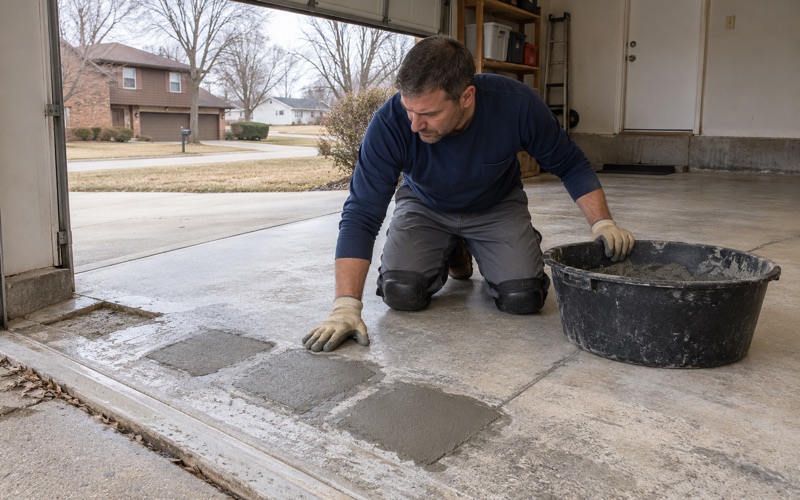
A smooth, impervious coating fails first where the slab underneath pushes moisture up. Our written scope includes a moisture test before the price is final, using ASTM F2170 in-situ relative humidity probes or an ASTM F1869 calcium chloride test as the slab allows. Cracks, spalls and old coatings are mapped before anything is ground.
If moisture is a risk, a moisture-mitigation primer can go into the system, and we explain up front that moisture is the first exclusion in a coating warranty. Cure schedules follow slab temperature and the dew point spread at the surface, not the calendar, so a suite owner gets a reopening time we expect to keep rather than a guess.
- 20+ Years in Epoxy Flooring
- Moisture Tested Before Pricing
- Coats and Thickness in Writing