West Des Moines Epoxy Flooring brings more than 20 years in the trade to epoxy flooring in Bondurant, and the floors we spend the most time thinking about here are the ones that sit under machine tools. A machining cell throws fluid every shift, and the slab beneath it either holds that fluid on a surface someone can clean or soaks it up and stays slick. That difference is decided long before the first coat goes down.
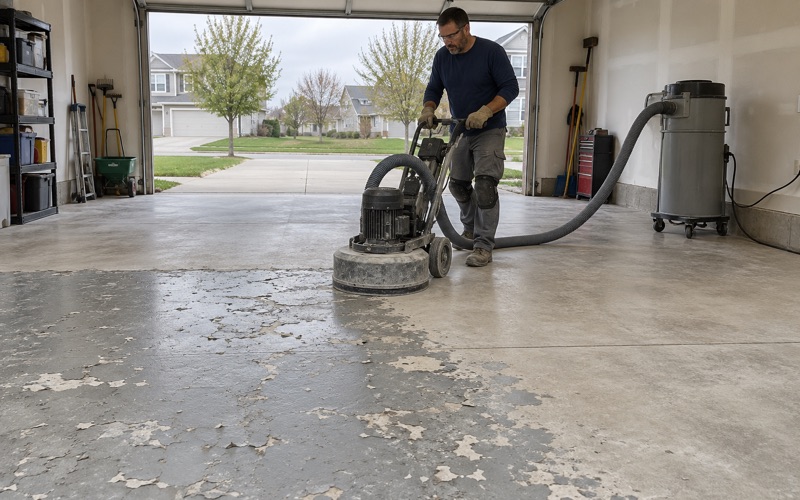
Our work on a production floor starts with the slab rather than the product catalog. We open the concrete with a diamond grinder or a shot blaster, never an acid etch, because a coating that has to stand up to coolant and daily scrubbing needs a real profile to grip. Grinding dust is pulled into a vacuum at the machine instead of being washed toward a floor drain.
Before a price is final, a moisture test is written into the scope, and the cracks, spalls and old coatings on the slab are mapped. The proposal then names the product line, the number of coats and the finished thickness, so a plant engineer or facility manager can hold the finished floor up against the quote.
Vermeer’s Plant and the Machining-Cell Floor
A 300,000-square-foot plant in the Timmins Industrial Park
Bondurant is a Polk County city that grew from 3,860 residents in 2010 to 7,365 in the 2020 census, an increase of 90.8 percent, and its industrial land has grown with it. On February 20, 2026, Vermeer announced that it had acquired 186 acres for a new 300,000-square-foot manufacturing facility, and the City of Bondurant places that land in the Timmins Industrial Park.
The park is a 187.74-acre site designated a General Industrial Park in January 2024. The city council approved a 102.7 million dollar project, the Iowa Economic Development Authority awarded more than 5.13 million dollars in Business Incentives for Growth, and the plant is expected to be operational by the end of 2027.
Machining, weld, paint and assembly under one roof
Vermeer’s release describes the new building as having full-spectrum manufacturing capability, including machining, weld, paint and assembly, with more than 300 jobs at the start. Its focus will be the Utility, Tree Care and Landscape product lines, while the current Des Moines team of 143 people has been building wear components in 108,000 square feet since spring 2023.
We have no relationship with Vermeer, and the plant’s floor specification and machining layout were not found in anything we read. What the announcement does tell us is the kind of work coming to Bondurant, and machining is the part of that list with the most direct consequence for a concrete floor. Welding, paint and assembly each raise their own floor questions, which this page leaves aside.
Why machining is a floor question
Machine tools run on metalworking fluids, the coolants and lubricants that carry heat and chips away from the cut. Even with guarding in place, fluid leaves the machine on parts, chips and tools and on the boots of the people working the cell. Over a shift, that adds up to a film on the floor around every machine. Chip bins, part racks and the walk path between the control panel and the door all sit inside that wet zone.
Whoever builds or fits out machining space in Bondurant, whether a large plant or a smaller job shop, inherits the same problem. The floor around the cell is a work surface that gets wet every day, and how it is finished decides how easily that fluid can be found and removed.
Looking for epoxy-flooring closer to Perry? See Epoxy-Flooring in Perry.
What OSHA’s Metalworking Fluids Manual Asks of the Floor
Wet and slippery surfaces are a named hazard
OSHA’s Metalworking Fluids: Safety and Health Best Practices Manual lists wet and slippery work surfaces among the additional hazards of working with these fluids. The manual is advisory and says plainly that it is not a standard or regulation and creates no new legal obligations. It is still the clearest federal description of what good housekeeping around a machine tool looks like.
The manual treats containment at the machine as the first line. Enclosures and splashguards are there to prevent metalworking fluids from spilling on the ground, which means the floor is the surface that catches whatever gets past them. A floor that hides a film of coolant makes that leakage harder to notice and harder to trace back to its source.
Spills cleaned up immediately, wash water kept separate
On housekeeping, the manual says that on a day-to-day basis, spills should be cleaned up immediately, and that cleaning of floors, equipment and the general work environment should be done by properly trained and equipped personnel. Immediate cleanup assumes a surface where a spill sits on top and can be squeegeed or mopped rather than drawn down into the slab.
It adds that wastes, including floor wash water, should not be dumped or swept into MWF sumps or coolant return trenches. We read that line as a reminder that cleaning the floor around a machine is its own waste stream, kept apart from the fluid the machines reuse. A floor that cleans well with a mop or an auto scrubber makes that separation easier to keep.
Slip-resistant shoes where floors are oily
The manual’s protective equipment guidance says that when floors of the work area are oily, safety shoes with slip-resistant soles should be provided. That is a footwear measure, and it stays in place whatever the floor is finished with. A better floor and the right shoes work together, and we never pitch one as a replacement for the other.
Nothing in the manual mentions floor coatings, so no coating can claim to satisfy it. The link we draw between its housekeeping guidance and a sealed, textured floor is our own inference: a surface that keeps fluid visible and cleanable supports the cleanup the manual asks for, alongside the slip-resistant shoes rather than in place of them.
Why Bare Concrete Stays Slick Under Coolant
Concrete drinks what lands on it
Bare concrete is porous, and even a hard-troweled industrial slab takes in liquid through its surface. Coolant that lands on it does not stay where a mop can reach. Part of it soaks into the top of the slab and comes back out as a damp, slick film long after the visible puddle is wiped up.
Over months, the stained zone around a machine darkens and spreads, and the floor near the cell never quite dries. People learn to step carefully there, which is exactly the condition the manual’s footwear guidance is written for. Scrubbing harder does not fix it, because the fluid that matters is already below the reach of the brush.
Densifiers and sealers do a different job
A lithium silicate densifier hardens the surface and reduces dusting, and it is a sound finish for plenty of warehouse floors. It does not build a film on top of the concrete, so it is not designed to hold fluid on the surface the way a resin coating does.
Thin penetrating sealers slow absorption for a while, but they wear in the lanes around a machine where carts, boots and chip bins run every day. Once they wear through, the slab goes back to drinking coolant, and the slick zone returns. Reapplying a sealer on a schedule is possible, but it means taking the cell down again and again for a result that never lasts long.
A new slab is tested, not assumed
A new building in an industrial park is usually coated at fit-out, when the slab is still young. A young slab carries water left from placement, and that moisture can push against a resin film from below. We test before we price, using ASTM F2170 in-situ relative humidity probes or ASTM F1869 calcium chloride testing as the slab and the schedule allow.
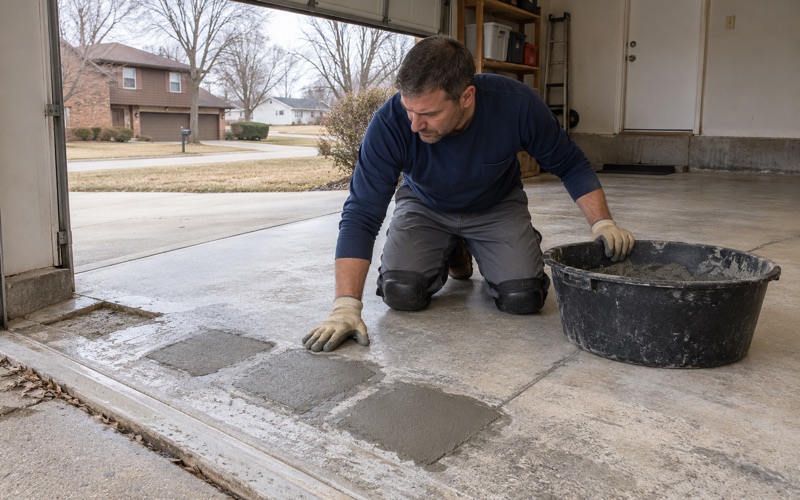
If the readings call for it, the proposal includes a moisture-mitigation primer rather than a hopeful wait. We also explain what a coating warranty leaves out before the job is sold, and moisture vapor transmission is the first exclusion we name. Cracks and joints found during mapping are noted in the same document, with a plain statement of whether the slab should be repaired before it is coated.
A Sealed, Textured Floor That Daily Cleanup Can Reach
Choosing the resin system
Around machining cells we generally look at a 100% solids epoxy body coat, or urethane cement where hot washdown or heavier abuse is expected, finished with a topcoat chosen for the fluids and cleaners the shop actually uses. The specific product line is named in the proposal along with the number of coats and the finished thickness.
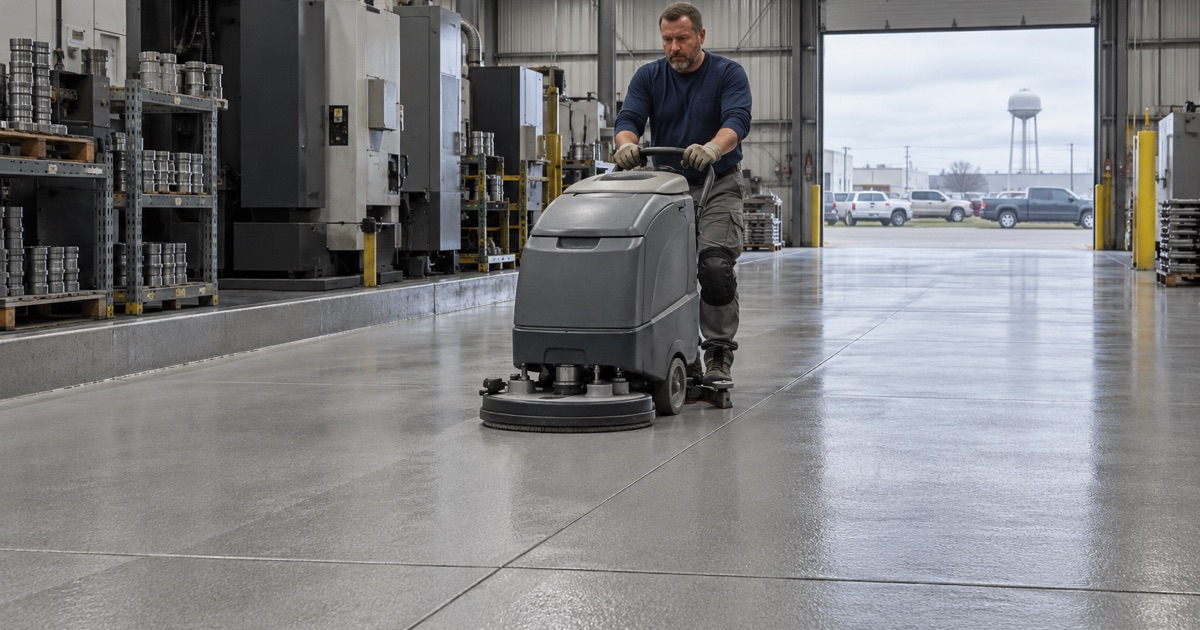
The point of the system is a continuous film with no open pores at the surface. Coolant that lands on it sits as a visible film or beads up, and the crew cleaning the cell can see what they missed before the next shift walks through it. A floor color that contrasts with the shop’s coolant makes that check quicker still.
Texture specified, not promised
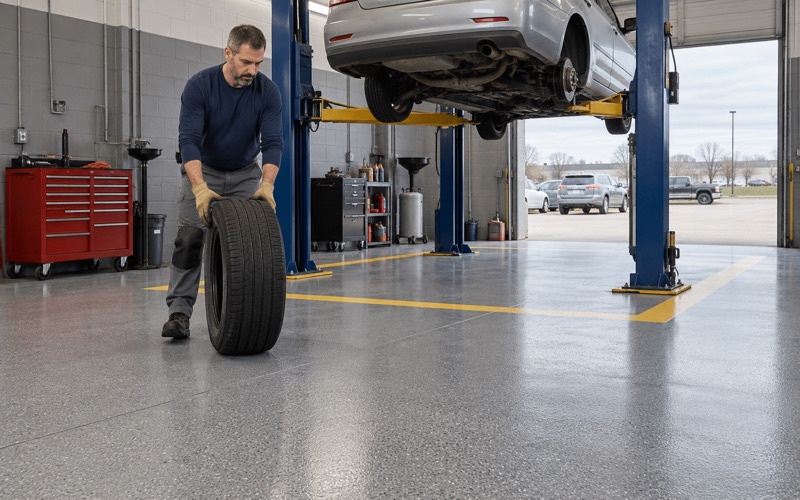
A smooth resin floor under coolant can be as slick as bare concrete, so texture matters as much as the resin underneath it. We specify the slip-resistant texture by the broadcast and the topcoat: a quartz aggregate broadcast locked in by a topcoat applied to leave the profile the owner chose.
There is a trade-off we explain at the start. More texture grips better underfoot but holds more fluid and takes more effort to clean, so the profile beside a machine is usually coarser than in an aisle or an office. No texture removes the need for prompt cleanup or proper footwear.
Scheduling around a running shop
A plant that is already producing cannot hand over its floor for a week. We phase the work around business hours, using overnight and weekend windows when a cell cannot stop, and we capture grinding dust at the machine so it does not settle into nearby equipment. Cells can be done one or two at a time, so the rest of the floor keeps producing while a section cures.
Cure is scheduled by slab temperature and the dew point spread at the surface rather than the calendar, because resin that cures cold or damp can develop amine blush and lose adhesion. Every industrial floor in Bondurant is ground, tested and mapped before we put a number on it, however new the building is.
- 20+ Years in Epoxy Flooring
- Moisture Tested Before Pricing
- Coats and Thickness in Writing