
West Des Moines Epoxy Flooring installs basement floor epoxy in West Des Moines, IA, serving surrounding cities including Clive, Windsor Heights, Waukee, Urbandale and Norwalk. In more than 20 years of coating concrete, we have learned that a basement floor is a water question before it is a color question, and every job we take starts there.
A basement slab sits in contact with the soil. Moisture can move up through it as vapor, and in a wet season water can be pushed against it from below. A coating laid over that without checking will blister, lift or turn cloudy, and the warranty almost never covers it. So we look at the sump pit, the drain tile and the slab itself, and we put a moisture test in the written scope before the price is final.
Once the slab passes, or once we know what primer it needs, we grind it to a real surface profile and build a system suited to how the room is used. The proposal lists the readings, the primer, the product line, the coats and the finished thickness, so nothing about the floor is left to memory.
Reading the Basement Before the Floor
Signs of past water
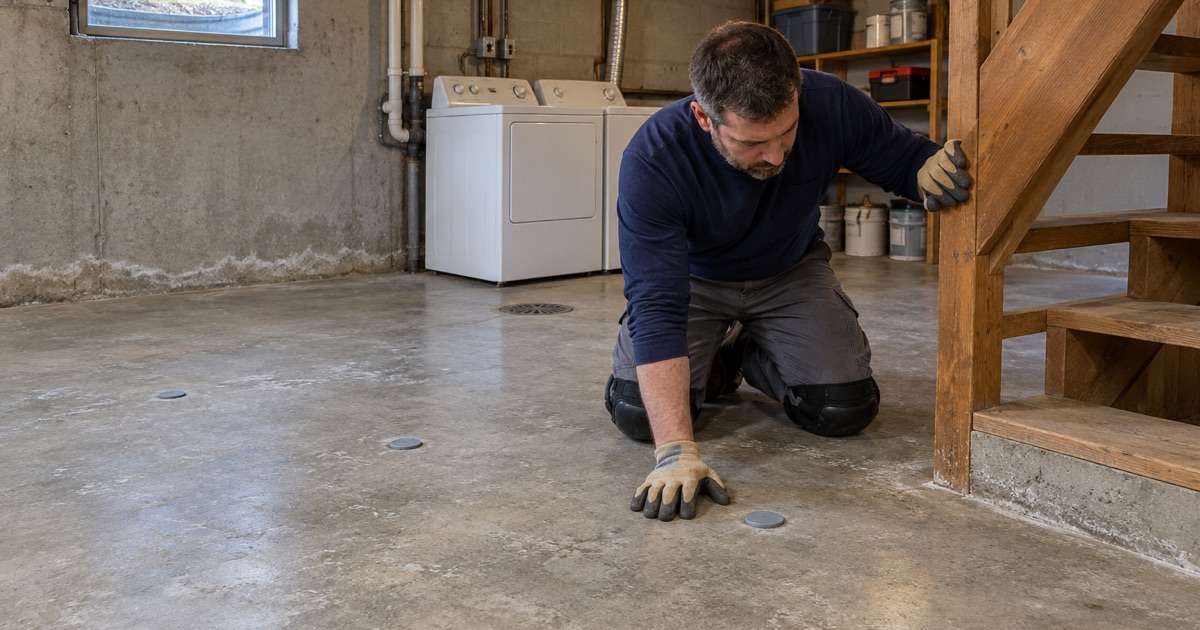
We start with the history the room shows. Water lines on walls and stair stringers, rust at the base of steel posts, staining around the floor drain, and swelling at the bottom of old paneling all tell a story. We also ask whether the basement has ever taken on water, and how recently.
A basement that flooded once in a storm decades ago is a different case from one that sees water every spring. The first may be fine to coat after testing. The second needs its drainage addressed before any coating goes down, because a coating will not hold back water that is still coming in.
Sump pits and drain tile
The sump pit is where the drain tile around the foundation delivers water. We look at the pit, the pump and the discharge, and note whether water is moving through it. A pit that cycles often in dry weather tells us the soil around the house holds a lot of water.
We detail the coated floor around the sump lid and any floor drains so water can still reach them, and we keep the pit accessible for service. A coated floor should work with the drainage system, never cover it or slope water away from it.
White powder and efflorescence
Efflorescence is a white, powdery deposit that forms when moisture carries salts through concrete and leaves them at the surface as it evaporates. It is common on basement floors and walls, and it is a reliable sign that moisture is moving through the slab.
We remove efflorescence before testing and treat its presence as a reason to look harder at the readings. Coating over it without addressing the moisture usually ends with the same salts pushing the coating up from below.
The soil the house sits in
West Des Moines spans two kinds of ground. Near Valley Junction the city sits on Raccoon River alluvium, while out toward Jordan Creek it reaches the edge of the Des Moines Lobe, where glacial till soils such as Clarion, Nicollet and Webster include poorly drained swales that can hold water near the surface.
We do not guess a slab’s moisture from a soil map, and we test on either side of town. What the soil does tell us is why two basements a few miles apart can read very differently, and why a dry-looking floor still gets a test before it gets a price.
Testing and Primers for Below-Grade Slabs
How we test a basement slab
We use ASTM F2170 in-situ relative humidity probes, which measure moisture inside the slab, or ASTM F1869 calcium chloride tests, which measure how much vapor is leaving the surface. An ASTM D4263 plastic sheet test serves as a quick screen but is not used alone to make a decision.
The readings are compared with the limits in the coating manufacturer’s literature and with the ASTM F710 moisture guidance for resilient floor preparation. They go into the proposal so you can see the numbers behind our recommendation.
When a moisture-mitigation primer is needed
When readings are higher than a standard primer can tolerate, we specify a moisture-mitigation primer. These are formulated to bond to damp concrete and resist vapor drive, so the coating above them stays attached.
A mitigation primer adds material and labor, so it adds cost. We show you why it is needed and what it does, and we do not recommend one where the readings say a standard primer is enough.
What the warranty leaves out
Nearly every coating warranty excludes damage caused by moisture vapor transmission and hydrostatic pressure. That exclusion matters most in basements, which is why we name it before the job is sold.
We walk you through the rest of the warranty too, including what it covers, what voids it and how claims are handled, so the terms are clear from the first conversation.
Systems for Lower Levels
Unfinished basements in new houses
In many newer houses, the basement slab sits over a vapor retarder, often a sheet meeting ASTM E1745, with drain tile and a sump pit around the foundation. That is a good start, but a young slab still holds water from placement. We test it like any other.
The best time to coat is before framing, when every edge can be ground and the whole slab is visible. A coated floor laid then runs under the future walls and gives a clean, sealed surface for the rest of the build.
Finished basements and walkouts
Walkout lower levels bring sliding doors, foot traffic from the yard and direct afternoon sun. Epoxy alone can amber in that light, so we often finish these floors with a polyaspartic topcoat that holds its color.
For finished family rooms, flake or solid color systems with a satin sheen hide dust and wear well under furniture. We plan textures for areas near doors and bathrooms where floors get wet.
Old paint, patching and adhesive
Older basements often have layers of paint, patching compound, tile adhesive and black mastic. All of it has to come off so the new system bonds to sound concrete.
We grind these layers away and capture the dust at the machine with a vacuum. Mastic removal takes extra time and is priced separately after we have seen the floor.
What a Basement Coating Is Not
Not waterproofing
A coating protects and finishes a slab, but it does not stop water. Hydrostatic pressure under a basement slab can push water through cracks and joints, and no floor coating is designed to hold it back.
If water is still getting in, the solution is drainage, grading, gutters or a waterproofing contractor. We will tell you if that is where the job needs to start, even if it means we do not coat the floor yet.
Not radon mitigation
A floor coating is never sold as radon work. In Iowa, radon testing and mitigation take a state credential under Iowa Code chapter 136B, and some newer homes are built with passive radon-resistant features under IRC Appendix AF.
We do not test for or mitigate radon, and a coating does not change that requirement. If radon is a concern, have the house tested by a credentialed professional.
After a flood
If a basement has taken on water, the cleanup and drying come first. West Des Moines still remembers the 1993 Raccoon River flood, and basements from that era may carry that history even after rebuilding.
We wait until the slab has dried, retest it and only then plan the floor. Coating too soon after a flood traps moisture under the system and sets it up to fail.
- 20+ Years in Epoxy Flooring
- Moisture Tested Before Pricing
- Coats and Thickness in Writing