West Des Moines Epoxy Flooring has spent more than 20 years on epoxy flooring in Ankeny and across central Iowa, and the floors that teach the most about this trade are the coldest ones. A freezer slab, a cooler aisle or a dock beside a refrigerated room puts a resin system through conditions a garage never sees, and the work only succeeds when it is planned around the slab rather than the calendar.
Every job starts the same way. We open the concrete with a diamond grinder or a shot blaster, never an acid etch, and we map the cracks, spalls and old coatings before a price is set. That profile is what gives a thick topping something to grip on a slab that will spend its life cold. When a slab needs repair or replacement before it should be coated, we say so in writing.
Our proposals name the product line, the number of coats and the finished thickness, so a facility manager can check the floor against the quote. On cold rooms that proposal also carries a temperature plan, because the hardest part of a freezer floor is not the coating. It is the schedule.
Ankeny’s Cold-Storage and Food-Distribution Floors
A Warehouse Measured in Hundreds of Thousands of Square Feet
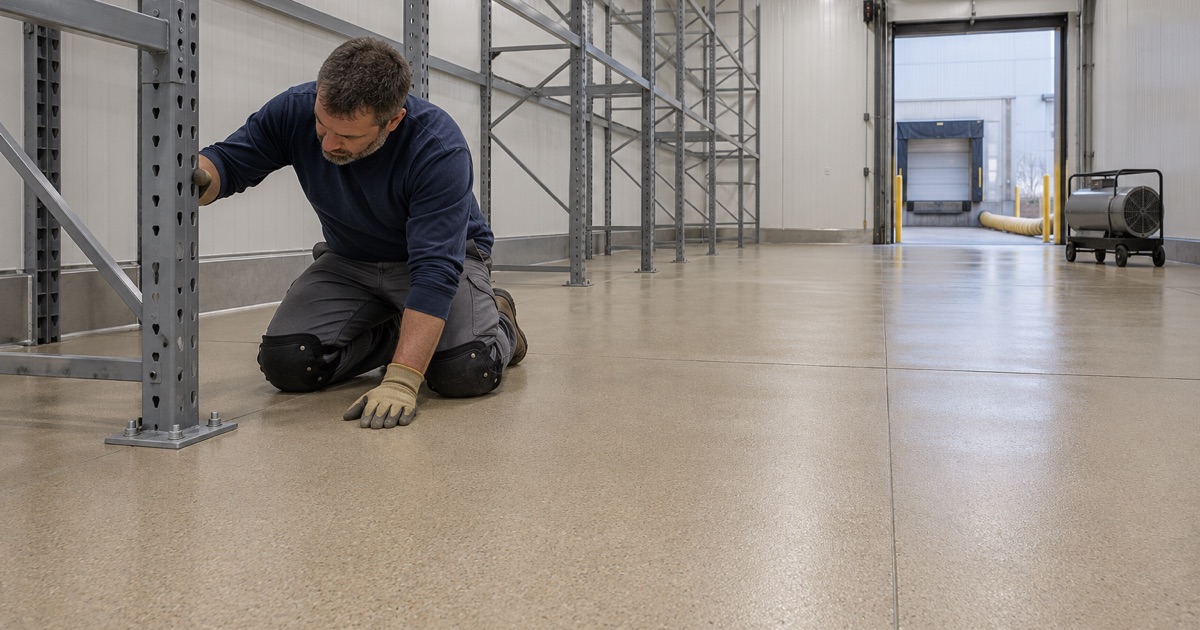
Ankeny is a Polk County suburb of Des Moines and one of Iowa’s fastest-growing cities, and its industrial side leans heavily on food. Perishable Distributors of Iowa, a Hy-Vee subsidiary, runs a cold storage warehouse and distribution center here served by ammonia refrigeration. City records reported by the Business Record put its 2021 expansion at about one-third, taking the building from 523,598 to 699,283 square feet on a permit valued at 38 million dollars.
We have no relationship with Perishable Distributors of Iowa or Hy-Vee, and we have not seen what is on that warehouse’s floors. We point to it because it shows how much refrigerated space this city carries, and the kind of floor problem that comes with it. Smaller cold rooms in the city face the same physics on a smaller scale.
What Changes When the Room Runs Below Zero
A cold room changes three things for a resin floor. The slab can sit far below freezing for years, forklift and pallet-jack traffic keeps working at the surface, and wash-down or an open door can swing the surface temperature quickly. A thin epoxy rolled out for a showroom is not built for that combination.
So a freezer job starts with the same diagnosis as any other slab, then adds questions a garage never raises. How long can the room be down, how warm can the slab be brought, and what does the refrigeration contractor need to know before the room goes back into service? Those answers shape the product, the crew size and how many days the room stays empty.
Docks and Coolers Beside the Freezer
Not every cold floor is a deep freezer. Cooler rooms, dock aprons and staging lanes next to refrigerated space see condensation, temperature cycling and heavy wheel loads, and each gets a system chosen for what actually happens on it. The distribution parks along I-35, such as Corporate Woods, Four Mile and Crosswinds, carry the same kind of dock floor without the freezer behind it. Dock floors also take some of the heaviest turning loads in a building, so we read their joints and edges closely before choosing a thickness.
Looking for epoxy-flooring closer to Polk City? See Epoxy-Flooring Services in Polk City.
Serves at -40, Installs at 45: The Freezer Floor’s Two Temperatures
What One Data Sheet Says
The clearest example we know is one manufacturer’s freezer-rated urethane cement, Sikafloor-20 NA PurCem, whose June 2024 data sheet lists freezers, coolers and thermal shock areas among its uses. In service it is rated to perform from -40 degrees F up to 248 degrees F. That is a product built for cold rooms, and we use it here as an example because its numbers are published, not as the only system we would consider.
The same sheet sets the application window far higher. Ambient air and substrate must be at least 45 degrees F and no more than 100 degrees F, the substrate at least 5 degrees F above the dew point, and the material conditioned to 65 to 75 degrees F before mixing. A floor that serves at -40 degrees still goes down on a slab of 45 degrees or warmer.
Why Those Numbers Belong to One Product
Those limits come from one product’s data sheet. They are not a building code requirement, and other systems carry their own windows. On every cold-room job we pull the data sheet for the exact product named in our proposal and plan around its numbers, not a rule of thumb.
What does carry across products is the logic behind them. Resin cures through a chemical reaction that slows sharply in the cold, and a slab colder than the air around it collects condensation on its surface. A freezer slab stays colder than the air for a long time once the room starts to warm. Coating over that film is how adhesion fails.
Dew Point and a Slab That Is Still Warming
The data sheet adds a warning that matters most on a freezer floor coming out of service: do not apply while ambient and substrate temperatures are rising, because pinholes may occur. A slab warming from deep cold pushes air out of its pores as it expands, and that air bubbles up through fresh material.
We measure slab temperature and the dew point spread at the surface, not just the room thermostat, and we wait for the slab to level off before the first coat goes down. Our cure schedules follow those readings, never a date picked in advance. If the readings will not hold inside the window, the coat waits.
Planning a Freezer or Cooler Shutdown Around the Floor
Emptying and Warming the Room
Freezer floor work begins weeks before we arrive. Product has to move out, racking may have to be cleared from the work area, and refrigeration has to be shut down or set back so the room can warm. A slab that held deep-freeze temperatures for years keeps that cold below its surface well after the air has warmed, so the warm-up takes longer than most owners expect.
We set the temperature targets from the product’s data sheet and agree on them with the facility’s own refrigeration and maintenance staff. Temporary heat may be needed to hold the slab inside the window through mixing, placement and early cure. We also ask where condensate and meltwater will go during the warm-up, so standing water is cleared before preparation starts.
Surface Preparation Under a Deadline
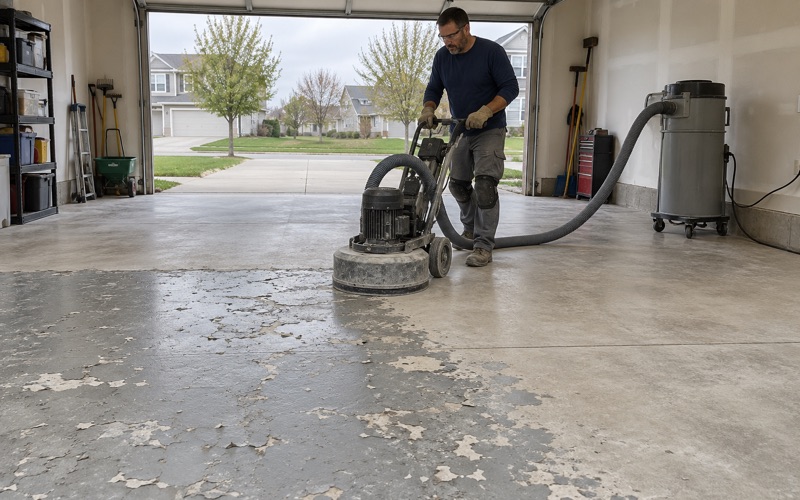
Once the slab is warm and dry, it is opened by diamond grinding or shot blasting to the concrete surface profile the system calls for. Grinding also tells us how sound the top layer is, since years of forklift traffic can leave it worn or loose in the travel lanes. Dust is captured at the machine with a vacuum rather than washed toward a floor drain, and damaged joints, spalls and failed old coatings are repaired before any topping goes down.
A moisture test sits in the written scope here as it does on any slab. Concrete that has been cold for years can hold moisture that only shows itself as it warms, and we name that risk before the price is final, because moisture is the first exclusion on a coating warranty.
Bringing the Room Back Down
The pull-down after the floor cures is part of the plan, not an afterthought. Dropping the temperature on a resin that has not finished curing can undo the care taken during installation. We give the facility the cure time the product requires before traffic and before temperatures drop, and we set that date together with whoever runs the refrigeration.
Where a room cannot close for long, the work can be phased by zone, and the offices, docks and warehouse aisles around it can be scheduled into overnight and weekend windows. Each zone still has to meet the same temperature conditions before it is coated.
Urethane Cement, Thermal Shock and What Lives Under the Slab
Why Urethane Cement Instead of Thin Epoxy
Urethane cement toppings go down far thicker than a garage coating; the product above is troweled at 6 to 9 millimeters, about 1/4 to 3/8 inch. Its data sheet describes a thermal expansion coefficient similar to concrete, which is what lets the topping move with the slab when the temperature swings instead of shearing away from it.
That matters wherever thermal shock happens: hot wash-down water hitting a cold floor, a freezer door opening onto a warmer dock, or steam cleaning in a processing room. The same sheet lists the product as steam cleanable at that thickness, with a wet dynamic coefficient of friction of about 0.62. A thin film coating has none of that mass to absorb the shock.
Texture and Product Choice Room by Room
Cold rooms are often wet rooms, so slip resistance is specified by the broadcast and topcoat we use, not promised as a slogan. A quartz aggregate broadcast into the system gives a texture that can be tuned to the traffic, and existing joints are carried through the topping rather than buried under it.
Away from the freezer, a cooler or a dry warehouse aisle may suit a 100% solids epoxy better than a urethane cement, depending on its temperature and cleaning routine. A production room that runs wet but never freezes can change the choice again. We name which system goes in which room, so every space can be checked against what was quoted.
Frost Heave Is a Subfloor Question
A freezer that runs for years can pull cold down through its floor into the soil below. Heat-trace vendor literature describes the result: the ground freezes, capillary action draws water into the frozen zone, and the growing ice can heave the freezer floor and damage the structure. The answer is subfloor heating and insulation designed into the building. When that protection fails or was never installed, the floor above shows it, whatever finish it carries.
No topping stops frost heave, and we never sell one as if it could. If a freezer floor shows lift or cracking that tracks with the refrigeration, we say so plainly and point the owner to the subfloor heating system, and to the engineer or refrigeration contractor responsible for it, before any coating is discussed.
- 20+ Years in Epoxy Flooring
- Moisture Tested Before Pricing
- Coats and Thickness in Writing