West Des Moines Epoxy Flooring has spent more than 20 years on epoxy flooring in Altoona and across the metro, and the first question we ask about any industrial floor is not what color it should be. It is what the floor is going to be hit with. A slab that carries foot traffic and a pallet jack needs one kind of system, and a slab where steel gets dropped, dragged and hammered on needs another.
That difference is what this page is about. Resinous floors come in duty classes, from a coat rolled on like paint to a mortar troweled down a quarter inch thick, and the class drives the price, the schedule and how long the floor lasts far more than the finish does. Picking the wrong class is the most expensive mistake an owner can make, because no topcoat fixes it later.
We write every proposal so that choice is visible. It names the product line, the number of coats and the finished thickness, which means an owner, a plant engineer or a general contractor can hold the installed floor up against the quote and check it.
Heavy Fabrication Is Coming to Altoona
Robinson’s Plant on the East Side of the Metro
Altoona has been known for warehouses and data centers, but its next large building is a factory. According to REjournals in January 2026, developer Enclave is building a 622,788-square-foot heavy-manufacturing build-to-suit for Robinson Inc., a custom metal manufacturer based in De Pere, Wisconsin. It is Robinson’s first building outside Wisconsin, and construction began in December 2025.
The space is planned for metal bending, large-format cutting, metal forming, welding, fabricating and assembly, with completion expected in Q1 2027 and about 100 jobs starting that year. We have no relationship with Robinson or Enclave, and the plant’s floor specification was not something we found. We raise it because it changes what kind of floor work Altoona needs.
Why a Fabrication Floor Is a Different Problem
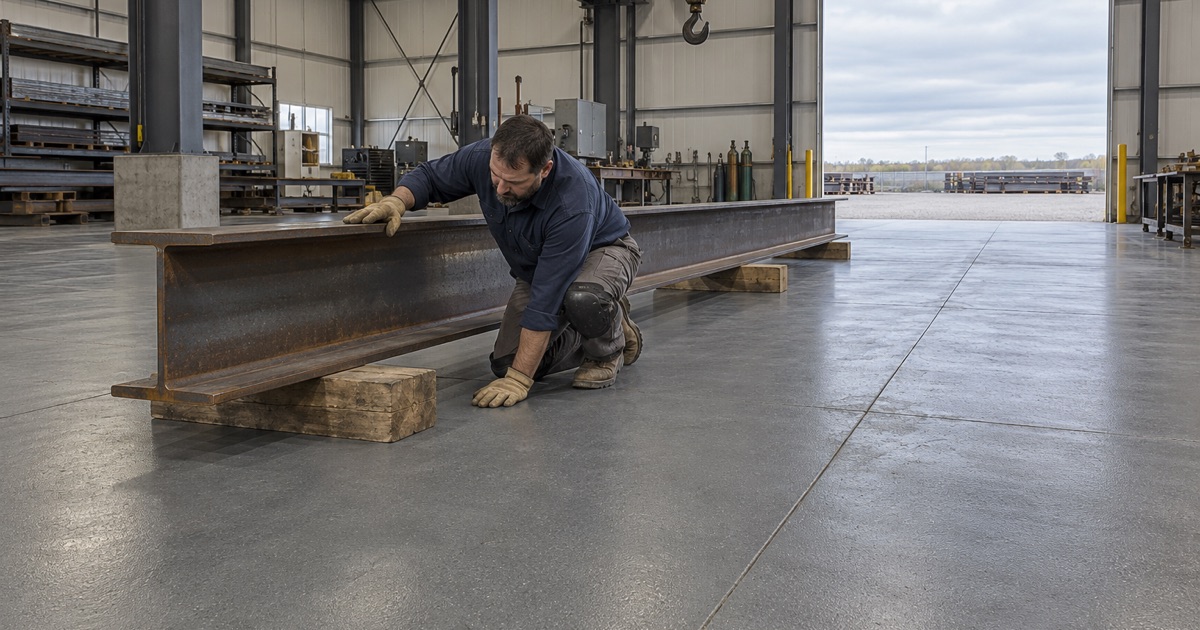
A warehouse floor mostly sees rolling loads. A fabrication floor sees things that fall: plate offcuts, fixtures, clamps, hand tools and parts that slip during assembly. Each drop delivers a sharp blow to one small spot, and a thin coating has almost nothing between that blow and the concrete underneath. Add grinding grit, cutting oils and parts dragged across the slab during setup, and the wear comes from several directions at once.
That is why fabrication space gets talked about in terms of impact rather than gloss or color. Gloss is the first thing a visitor notices and the last thing that matters once a press brake is running. The useful question for any shop in Altoona, whether it is a plant the size of Robinson’s or a single-bay welding shop, is which duty class matches the worst thing that will land on the floor in an ordinary week.
Looking for epoxy-flooring closer to Winterset? See Epoxy-Flooring Services in Winterset.
Film, Slurry or Mortar: Floors Sold by Duty Class
Thin Films Rolled On
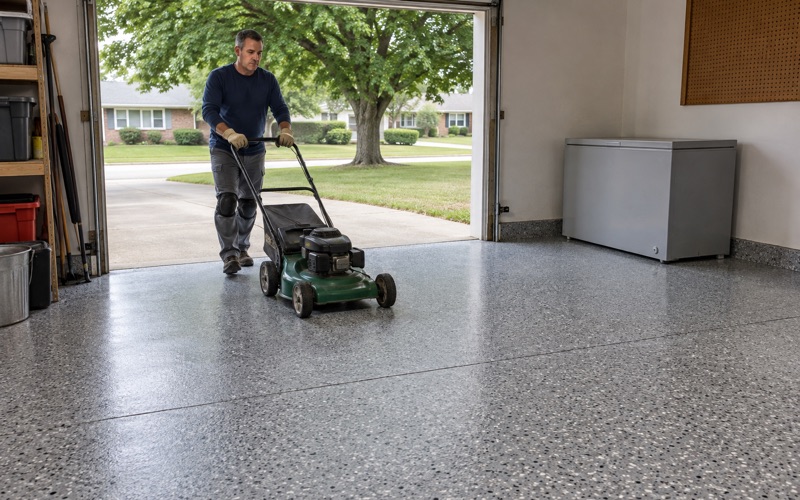
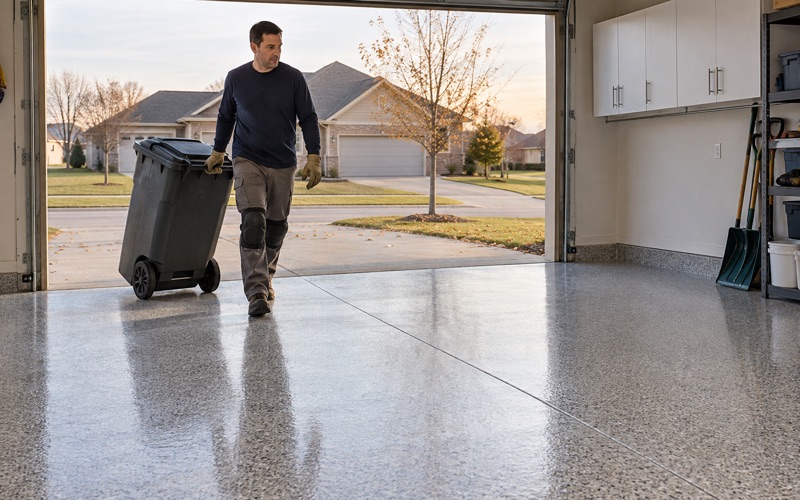
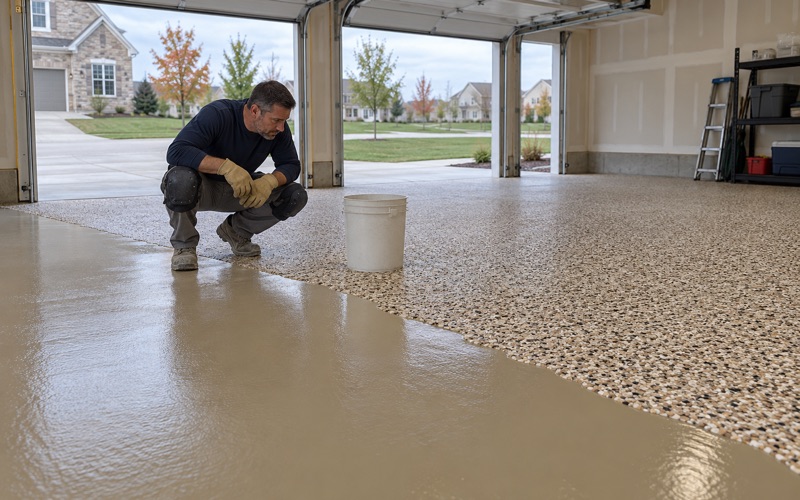
The lightest class is a film: a primer and one or two coats of epoxy or a polyaspartic topcoat applied with a squeegee and roller. Done properly over a ground slab, a film is a good floor for a clean assembly room, a storage area or a garage. It resists stains, cleans easily and brightens the space. It is also the class most Altoona homeowners buy for a garage, where we choose the system to stand up to the brine and rock salt that ride in on tires from November through March.
What a film does not have is bulk. It is a thin skin bonded to the concrete, so a dropped piece of steel can chip through it to the slab. On a fabrication floor, a film is a cosmetic layer, and we tell owners that before they choose it on price.
Self-Leveling Slurries and Broadcast Systems
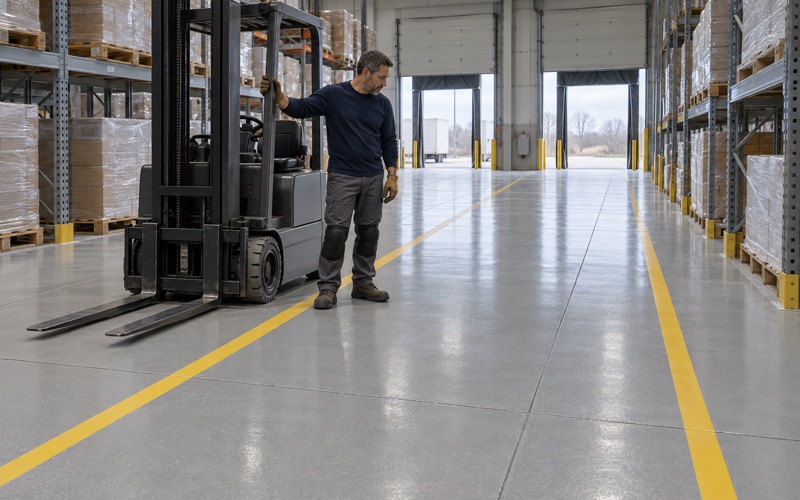
The middle class builds thickness in layers. A 100% solids epoxy slurry or a broadcast system, with quartz aggregate seeded into each wet coat and locked in by the next, produces a floor several times thicker than a film. The aggregate adds wear resistance and lets us specify a slip-resistant texture by the broadcast size and the topcoat, rather than promising one.
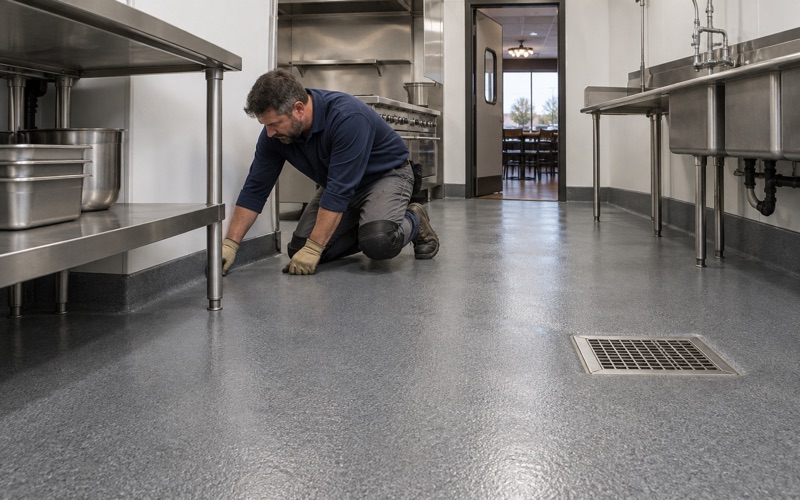
These systems suit maintenance bays, light assembly lines and loading areas where carts and pallet jacks run all day, and they hide the scuffs a busy shop leaves far better than a smooth film. Urethane cement belongs in this conversation too, for areas that see heat or washdown. Under heavy drops, though, a broadcast floor is still a coating, not armor.
Troweled Epoxy Mortar
The heavy class is a troweled mortar: resin mixed with graded aggregate and placed with a power trowel or hand trowel at 1/8 to 1/4 inch. One maker’s data sheet, for Stonhard’s Stonclad HT, describes a four-component troweled epoxy mortar at that thickness that cures to an impact-resistant, abrasion-resistant surface, with a lab compressive strength of 11,500 psi.
A mortar like that is the class that belongs under bending, forming and welding work. We have no relationship with Stonhard and cite the sheet only because it states its numbers plainly. Other makers publish comparable mortars, and the proposal names whichever line we are actually quoting. A mortar costs more and takes longer to place than a film, which is exactly why it should go only where the work demands it.
What an Impact Rating Means and Does Not Mean
Reading the ASTM D2794 Number
Impact figures on data sheets usually come from ASTM D2794, a falling-weight test in which a weight is dropped onto a coated panel and the result is reported in inch-pounds. The Stonclad HT sheet reports more than 160 in.-lbs. That is a meaningful way to compare one system with another under the same test, and it is the number to ask for when two quotes describe their floors in different words.
It is a lab value, and the maker says field values may vary. A floor’s real resistance also depends on the slab beneath it, the bond to that slab and the shape of what lands on it. A sharp corner of plate concentrates a blow in a way a test weight does not, so no rating makes a floor indestructible.
The Rest of the Data Sheet Matters Too
The same sheet carries conditions that are easy to skip. It calls for fiberglass reinforcement where the floor sees instant temperature changes greater than 100 F, requires the substrate and components to be between 60 and 85 F to install, and lists 8 hours to foot traffic and 24 hours to normal operations at 77 F.
Those temperatures are why our cure schedules follow slab temperature and dew point rather than the calendar. An unheated building shell in a central Iowa winter does not meet them, and we would rather move a start date than install outside the range the maker wrote down.
A Mortar Still Does Not Stop Water
Thick is not the same as sealed. The Stonclad HT sheet states that where the total system must keep water out, a separate membrane system is required. A troweled mortar resists impact and wear; it is not a water barrier for a floor above occupied space, a pit or a washdown area.
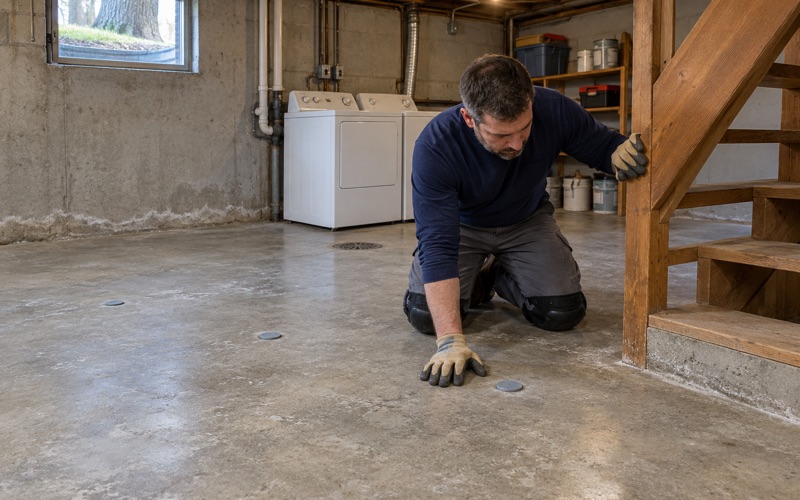
The same honesty applies to moisture coming up from below. We put a moisture test in the written scope before the price is final, using ASTM F2170 relative humidity probes or ASTM F1869 calcium chloride testing as the job calls for, and moisture is the first warranty exclusion we name.
Deciding the Floor Before the Building Is Done
The Build-to-Suit Moment
The cheapest time to choose a floor’s duty class is while a build-to-suit is still on paper. At that stage the owner, architect and general contractor can match the slab finish to the coating, plan where the heavy zones are, and schedule the resin work for when the building is closed in and heated. Once the floor is poured and the line is running, every option costs more.
We can price a floor at the specification stage, before the slab is placed. That lets an owner compare a film, a broadcast system and a troweled mortar for each area of the plant instead of discovering at move-in that one product was assumed everywhere. A written thickness in the specification also gives the general contractor something to inspect against, rather than a line that just says epoxy.
Zoning the Floor by What Happens on It
Few plants need one system wall to wall. Offices, break rooms and clean storage can take a film, aisles and assembly lines a broadcast system, and the cells where steel is bent, cut and welded a mortar. Drawing those lines on the floor plan is how a heavy floor stays affordable. Where two classes meet, we plan a clean, ground-in termination so the thinner system does not lift at the edge of the thicker one.
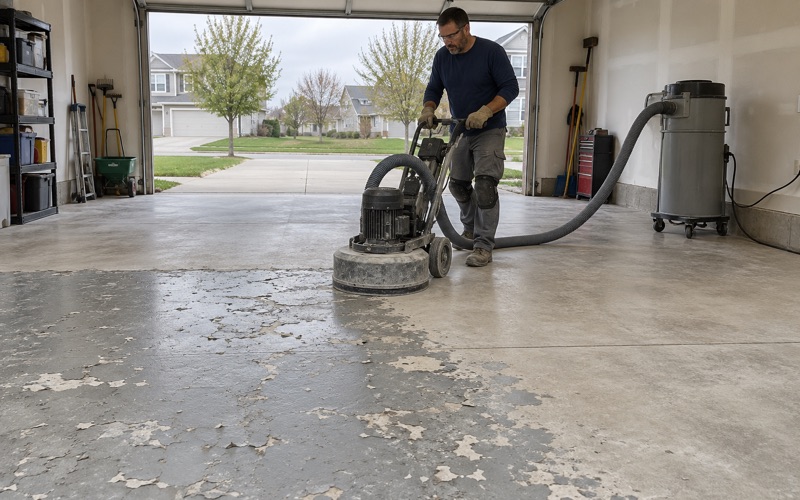
Whatever the class, the prep is the same. Every slab is opened with a diamond grinder or a shot blaster to an ICRI concrete surface profile the product calls for, never acid etched, and the dust is captured at the machine by a vacuum rather than washed toward a drain.
Smaller Fabrication Shops Across Altoona
Altoona, a Polk County city of 19,565 at the 2020 census, has far more industrial floor than its size suggests. Altoona Now reported roughly 2.7 million square feet of warehouse space built or under construction in 2023, and buildings such as the 265,700-square-foot Altus Commerce Center Building A and the 300,000-square-foot I-80 Distribution Center were listed with 7-inch slabs. Tenants in buildings like those include small fabricators, sign shops and equipment repair operations.
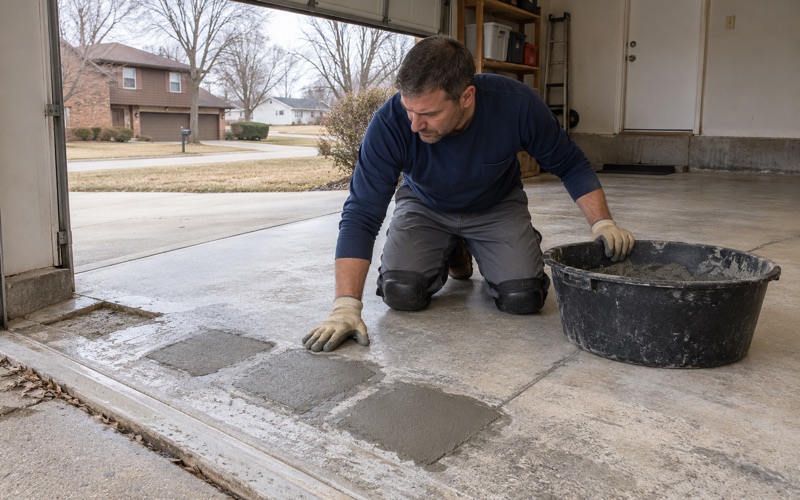
For a shop leasing part of an existing building, the slab already exists, so the work starts by mapping its cracks, spalls and any old coating. If the concrete needs repair or replacement before it should be coated, we say so. Then the duty-class choice is the same one a large plant makes, just on a smaller floor plan, and we phase the work around business hours with overnight and weekend windows when the shop cannot close.
- 20+ Years in Epoxy Flooring
- Moisture Tested Before Pricing
- Coats and Thickness in Writing