West Des Moines Epoxy Flooring has spent more than 20 years putting down epoxy flooring in Adel and across central Iowa, and every job starts with the slab rather than the coating. We open the concrete with a diamond grinder or a shot blaster, never an acid etch, so the resin has a real profile to grip. Then we test for moisture before the price is settled, because a figure on a proposal means little until we know what is coming up through the concrete.
Our written proposals name the product line, the number of coats and the finished thickness. That lets a shop owner or a homeowner hold the installed floor up against the quote and see whether the two match. Cracks, spalls and old coatings get mapped on the first visit, and when a slab needs repair or replacement before anything should go on it, we tell you so plainly instead of coating over the problem.
Much of this page is about one kind of floor that matters in a town that makes things: the concrete under a powder coating operation. Garages, basements and commercial spaces get the same preparation discipline, and we cover what changes for them toward the end. Whatever the room, the goal is a floor that does its job and is easy to keep clean.
Harrow Tines, Powder Coat and the Floor Underneath
Farm equipment parts made on Greene Street
Adel is the county seat of Dallas County and sits along the North Raccoon River, but it is also a place where farm equipment parts are made. Iowa Spring Manufacturing opened in Adel in 1977 and specializes in harrow tines and double torsion springs for agricultural equipment, with its first plant on Greene Street. The company built a second facility in town in 2023 to accommodate its growth.
Iowa Spring lists custom paint and powder coating among its value-added services. We have no relationship with the company and have never worked in its plants. We mention it because it shows that powder coating is part of how finished parts leave Adel, and powder coating is the kind of operation whose floor carries a specific federal expectation.
What the spray finishing standard says about floors
The federal standard for spray finishing with flammable and combustible materials, 29 CFR 1910.107, has a housekeeping section for powder coating. It says all areas shall be kept free of the accumulation of powder coating dusts, particularly horizontal surfaces such as ledges, beams, pipes, hoods, booths and floors. Floors are named outright, not left to inference.
The next line governs the method as well as the result: surfaces are to be cleaned in a manner that avoids scattering dust to other places or creating dust clouds. The same standard calls for No Smoking signs at powder coating areas and powder storage rooms. Taken together, the rule describes a room where powder is collected where it lands, not pushed somewhere else.
What a coating can and cannot do here
None of that is satisfied by a floor product on its own. No coating carries an OSHA approval, and a sealed floor does not ground electrostatic equipment, replace a cleaning routine or remove the hazard that fine powder presents. Anyone who tells you otherwise is selling a label, not a floor.
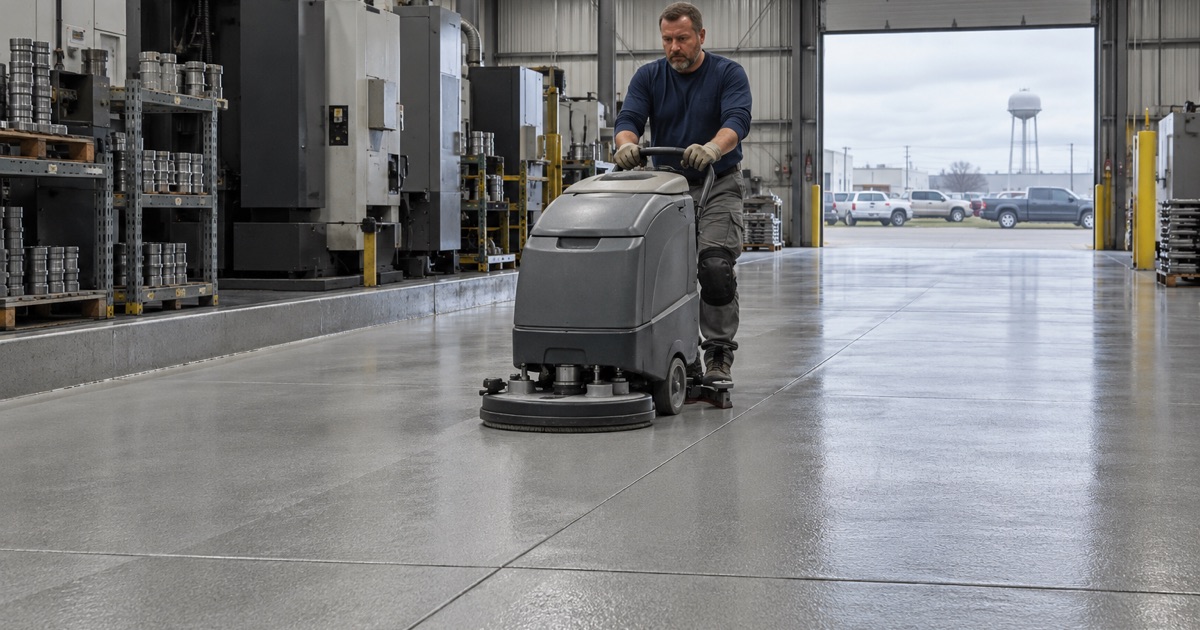
What a well-built floor can do is make the housekeeping the standard asks for easier to carry out properly, shift after shift. That is the honest scope of our work in a finishing area: we build a surface that gives up its powder to a vacuum, and the shop’s own program keeps it that way.
Looking for epoxy-flooring closer to Pleasant Hill? See Epoxy-Flooring Services in Pleasant Hill.
Why Powder Settles Into Bare Concrete
Open pores hold fine particles
Bare concrete is porous, and a slab that has been driven on and worn for years develops an open, rough surface. Fine overspray drifts down, settles into that texture and lodges in pores and hairline cracks, where a broom moves only the top layer. The rest stays in the slab, waiting for the next cart wheel or boot to kick it loose.
Every pass with a dry broom also lifts some of that powder back into the air, which is the opposite of what the standard asks. An unsealed slab that sheds its own cement dust as it wears adds to the load on top. The floor ends up being one of the hardest surfaces in the room to keep clean, even though it is the one people look at least.
Sealing the surface so powder stays on top
A properly bonded coating closes those pores, so overspray rests on a continuous surface instead of sinking in. A 100% solids epoxy body coat under a smooth or lightly textured topcoat gives powder nothing to hide in, and a vacuum can lift it in a single pass. Polyaspartic and polyurea topcoats are options where faster return to service or better abrasion resistance matters.
Texture is a trade-off we talk through rather than default to. A heavy quartz aggregate broadcast adds grip but also gives fine powder more valleys to settle into. In a finishing area we usually specify a finer texture, chosen by the broadcast and topcoat we name in the proposal, and we weigh it against the slip risk of that particular space.
Joints, cracks and edges
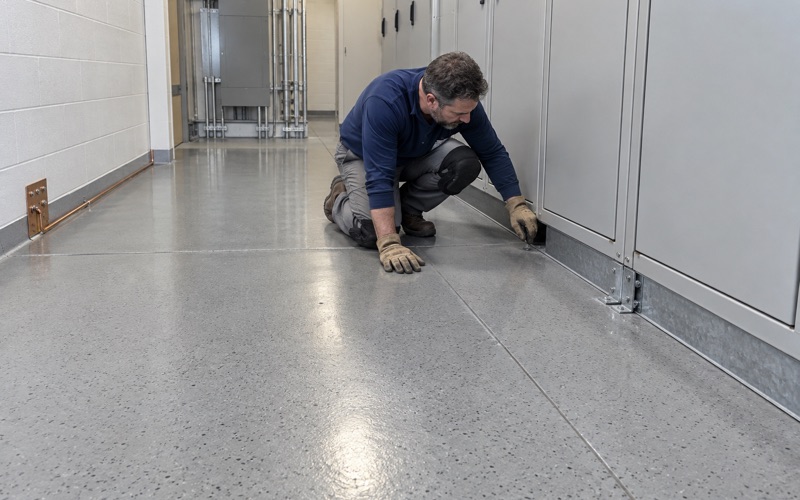
Powder collects wherever a floor breaks: saw cuts, cracks, spalled edges and the line where a slab meets a wall or a booth base. We map those before grinding, then fill or treat them so the finished floor does not keep a strip of trapped powder along every joint.
Some joints have to stay open because the slab moves. When that is the case we say so and plan how the joint will be cleaned, rather than pretending a sealant bead will never catch dust.
Cleaning Without Raising a Dust Cloud
Vacuums instead of brooms and compressed air
The requirement to avoid scattering dust rules out the habits that feel fastest on a busy day: blowing a floor down with compressed air or sweeping hard with a stiff push broom. Both move powder from the floor up onto the ledges and beams the same standard lists, and into the air in between. A crew can spend an hour cleaning and leave the room with the same amount of powder, only redistributed.
A sealed, sweepable floor is what makes the gentler method practical. When powder sits on a closed surface, a vacuum suited to the shop’s dust collects it instead of chasing it out of concrete pores. Where the shop’s own procedures allow, a damp mop can follow without the coating soaking up water and residue the way bare concrete does.
Our own grinding dust follows the same idea
We hold our preparation work to the same habit. Dust from diamond grinding and shot blasting is captured at the machine with a vacuum, not swept into piles and not rinsed toward a floor drain or a storm inlet.
In an operating plant that matters twice over. Our dust does not settle on finished parts, racks or equipment, and the floor we hand back starts clean instead of starting with a layer of concrete fines in every corner.
Scheduling around production
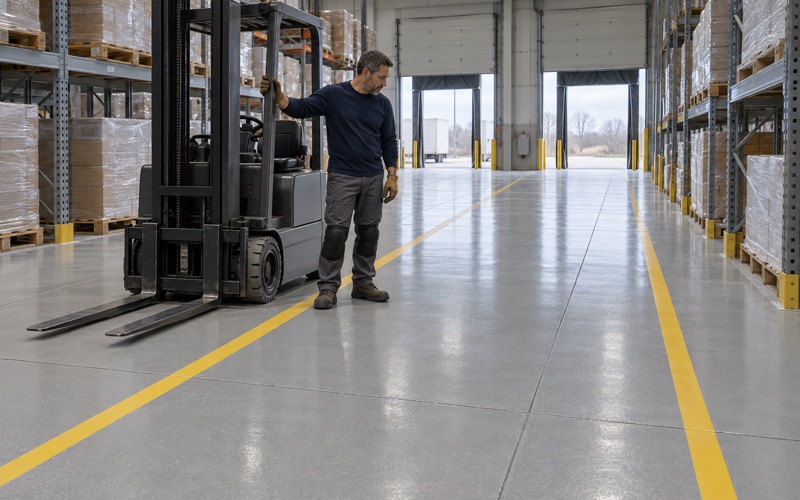
A finishing line that cannot stop for a week needs its floor done in sections. We phase commercial and industrial work around business hours, using overnight and weekend windows when a space cannot close, and we agree the sequence in writing before the first section is ground.
Cure schedules follow slab temperature and the dew point spread at the slab surface, not the calendar. A cold shop slab in a central Iowa winter cures more slowly, and rolling a parts cart across it early is how a new coating gets marked before it ever sees powder. When conditions risk amine blush or a soft cure, we wait.
Choosing a Floor Around Booths, Ovens and the Rest of Adel
Booth floors and noncombustible coverings
The standard says that where a spray booth floor and the operator’s working area are combustible, they are to be covered with noncombustible material that makes residues safe to clean and remove. That is a question for the booth manufacturer, the shop’s insurer and its safety program. We do not present a resin coating as the answer to it.
On the concrete around a booth, we choose a system for how readily it releases residue and how it holds up to carts, racks and repeated cleaning. Each layer is named in the proposal, so the shop knows exactly what is on its floor.
Moisture and heat near cure ovens
Floors near a cure oven see warm racks and carts crossing the same path all day. We look at that traffic lane and the heat exposure at the oven mouth before choosing a topcoat, and a urethane cement system is on the table where heat and abuse call for it.
Moisture testing still comes first. An ASTM F2170 in-situ relative humidity probe or an ASTM F1869 calcium chloride test tells us whether the slab needs a moisture-mitigation primer. Before the job is sold we also explain what a coating warranty leaves out, and moisture vapor transmission is the first exclusion we name.
Garages and basements across town
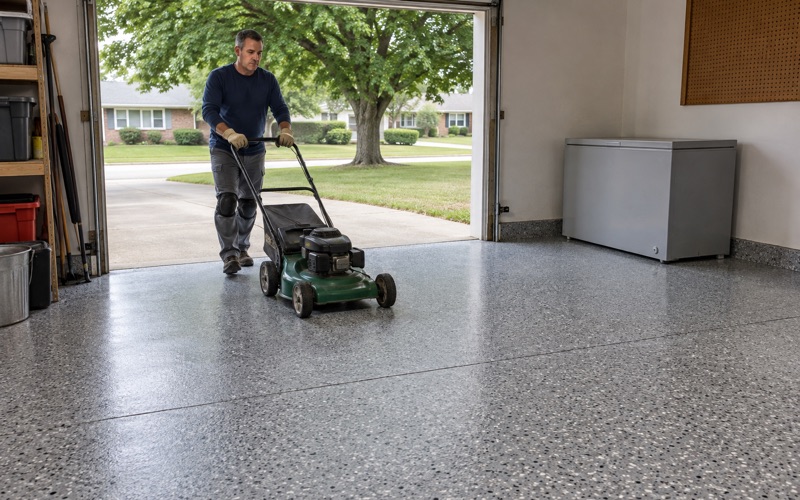
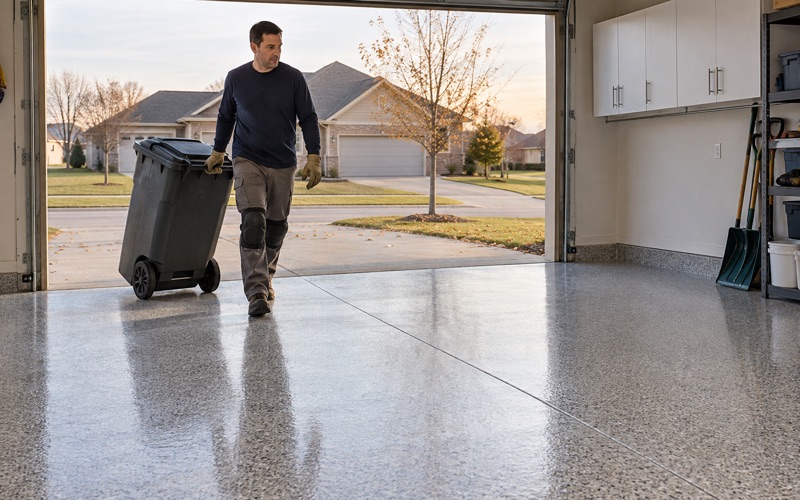
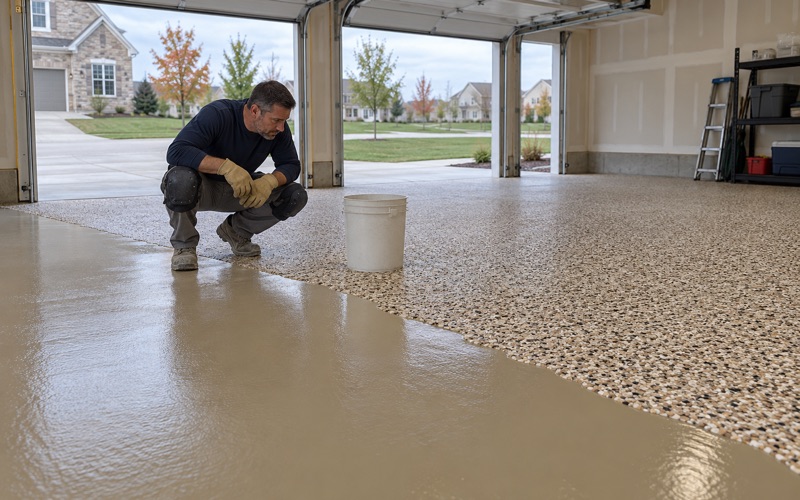
Adel’s homes run from a 1939-or-earlier core, 15.7 percent of units, to recent construction, with 39.9 percent built since 2010. We test a garage slab in a new subdivision exactly as we test one in an older house, because a newer house is not a safer garage. Systems for garages are chosen to stand up to the brine and rock salt that ride in on tires from November through March.
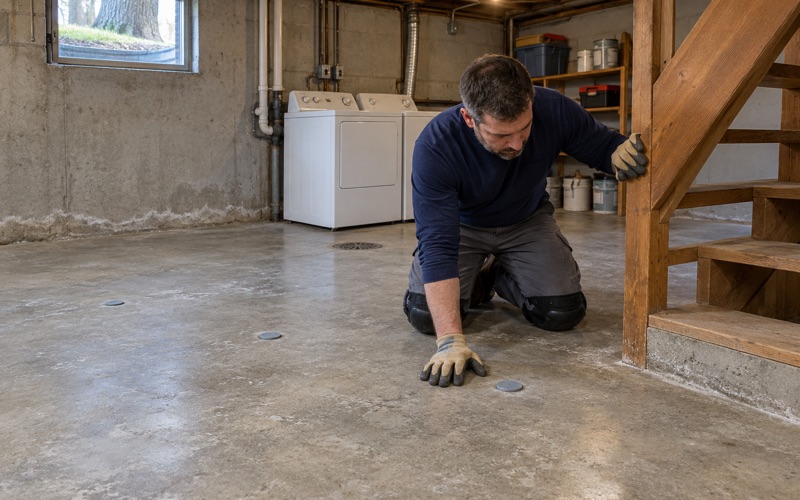
In a basement we read the floor for past water first and check the sump pit and drain tile, because a coating does not stop seepage. It is never radon work either; in Iowa, radon testing and mitigation take a state credential. Low-odor products are available for attached garages and basements as a comfort choice that shortens the wait before you move back in.
- 20+ Years in Epoxy Flooring
- Moisture Tested Before Pricing
- Coats and Thickness in Writing